

Navigating Medical Research for Mental Health: A Patient's Guide to Google Scholar
Google Scholar is a free, publicly accessible search engine that indexes the full text or metadata of scholarly literature across an array of publishing formats and disciplines. For patients, it provides a powerful tool to look beyond headlines and directly access peer-reviewed studies on mental health treatments.
In the world of mental healthcare, making an informed decision can feel overwhelming. You are often presented with a sea of information, from anecdotal stories on forums to broad summaries on health websites. But for those who want to understand the scientific foundation of their options, learning how to vet primary sources is an act of empowerment. This guide is designed to help you use tools like Google Scholar to explore the evidence behind innovative treatments, giving you the confidence to engage in deeper conversations with your care team.
Why Peer-Reviewed Evidence is Your Strongest Ally
When you are struggling with a persistent condition like treatment-resistant depression, you deserve a care team that is as invested in the scientific evidence as they are in your personal well-being. Large, impersonal health systems can sometimes be slow to adopt newer, evidence-informed protocols. In contrast, a psychiatrist-led practice like Lumin Health is built upon the very research you can find and explore yourself.
Understanding this research helps you move from being a passive recipient of care to an active partner in your own journey toward relief. It helps you ask more precise questions and better understand the "why" behind a potential treatment path, such as ketamine therapy.
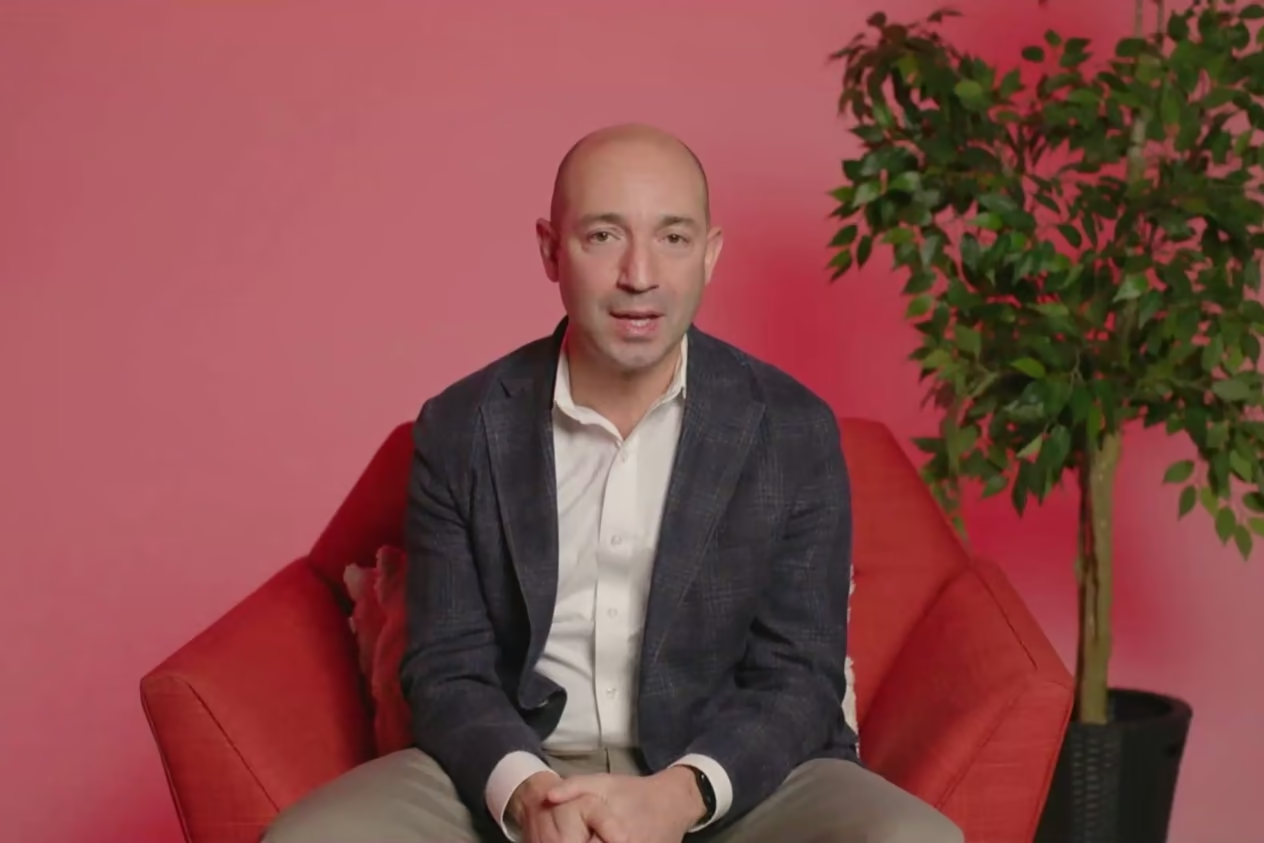
Dr. Ben Yudkoff, Chief Medical Officer at Lumin Health, states: "Our role is not to simply prescribe a treatment, but to be a trusted guide. When a patient comes to us having engaged with the research, it elevates the entire conversation. It allows us to build a therapeutic alliance based on shared understanding and mutual respect, which is the cornerstone of meaningful healing."
How to Use Google Scholar for Mental Health Research: A Step-by-Step Process
Navigating an academic database for the first time can be intimidating. Here is a simple, structured approach to get you started.
- Formulate a Specific Search Query: Vague searches yield vague results. Instead of "depression treatment," try more specific, clinical terms. Good examples include: "esketamine for major depression with suicidal ideation," "IV ketamine treatment and neuroplasticity," or "efficacy of Spravato for TRD."
- Filter for Recent and Relevant Studies: On the left-hand sidebar, you can filter results by publication date. For rapidly evolving fields like psychedelic medicine, filtering for studies published in the "last 5 years" is often a good practice to see the most current evidence.
- Focus on the Abstract First: The abstract is a dense summary at the beginning of every paper. It will tell you the study's purpose, methods, key findings, and conclusion. Reading the abstract is the most efficient way to determine if the full article is relevant to your questions.
- Identify High-Impact Study Types: Not all research is created equal. Look for keywords that signal high-quality evidence, such as "randomized controlled trial (RCT)," "meta-analysis," or "systematic review." These are generally considered more robust than case studies or observational studies.
- Review Author Affiliations and Journals: Note where the research is coming from. Studies published in high-impact journals (like The Lancet or the American Journal of Psychiatry) and authored by researchers at reputable universities or medical institutions carry more weight. This is a key part of the peer-review process.
A Case Study: Researching Ketamine and Esketamine
Let's apply this process to one of the most significant recent advancements in psychiatry: the use of ketamine and its derivatives for depression.
Understanding the Science: Neuroplasticity and the "Stuck" Brain
For decades, the prevailing model of depression focused on chemical imbalances. Newer research, however, illuminates how chronic stress can change the brain's physical structure, leading to rigid, negative thought patterns. Your brain isn't broken—it may be stuck in a rut, a state often governed by an overactive Default Mode Network (DMN).
Treatments like ketamine for depression work on a different axis. They are thought to promote rapid neuroplasticity—the brain’s ability to form new neural connections. A landmark study published in Science found that ketamine can induce a rapid increase in synaptic connections in the prefrontal cortex. This biological process can create a receptive window for change, making the work done in psychotherapy more effective.[4]
Spravato® vs. Off-Label Ketamine Therapy
Using Google Scholar helps clarify critical distinctions that are often blurred in general media. Here’s what the evidence says:
- Spravato® (esketamine): This is a specific form of the ketamine molecule. It must always be identified as the first and only psychedelic-like medicine that is FDA-approved for adults with treatment-resistant depression (TRD) and for major depressive disorder with acute suicidal thoughts or behavior (MDSI)[5,6]. It is administered as a self-administered nasal spray under medical supervision at a certified site like Lumin Health.
- Ketamine Therapy (IV/IM): Intravenous (IV) or intramuscular (IM) ketamine has been used for decades as an anesthetic.[7] Its use for depression is an evidence-informed, off-label option that has been validated by a vast body of research, including pivotal work from the National Institute of Mental Health.[1,2] A 2017 consensus statement from the American Psychiatric Association, available via[3] JAMA Psychiatry, provides guidance on its safe use.
Understanding this distinction is vital. It is the difference between a formally approved protocol and a well-researched clinical option. At our Boston-area practice, we provide both FDA-approved Spravato and evidence-informed intramuscular (IM) ketamine treatment, tailoring the approach to each individual's clinical needs.
From Information to Conversation
Engaging with research on Google Scholar is not about becoming your own doctor. It is about becoming a more informed, empowered, and confident partner in your own care. It transforms your consultations from a monologue into a dialogue.
At Lumin Health, our academically-affiliated leadership is committed to this model of patient-centered care. While our physical locations are based in Massachusetts, we hope this guide serves as a valuable resource for anyone, anywhere, looking to take an active role in their mental health journey.
If you are exploring whether an evidence-informed treatment like ketamine therapy may be a fit for you, we would be grateful to walk with you towards relief.
References
- Bobo WV, Vande Voort JL, Croarkin PE, et al. KETAMINE FOR TREATMENT-RESISTANT UNIPOLAR AND BIPOLAR MAJOR DEPRESSION: CRITICAL REVIEW AND IMPLICATIONS FOR CLINICAL PRACTICE. Depress Anxiety. 2016;33(8):698-710. PubMed
- Kishimoto T, Chawla JM, Hagi K, et al. Single-dose infusion ketamine and non-ketamine N-methyl-d-aspartate receptor antagonists for unipolar and bipolar depression: a meta-analysis of efficacy, safety and time trajectories. Psychol Med. 2016;46(7):1459-72. PubMed
- Sanacora G, Frye MA, McDonald W, et al. A Consensus Statement on the Use of Ketamine in the Treatment of Mood Disorders. JAMA Psychiatry. 2017;74(4):399-405. PubMed
- Li N, Lee B, Liu RJ, et al. mTOR-dependent synapse formation underlies the rapid antidepressant effects of NMDA antagonists. Science. 2010;329(5994):959-64. PubMed
- Popova V, Daly EJ, Trivedi M, et al. Efficacy and Safety of Flexibly Dosed Esketamine Nasal Spray Combined With a Newly Initiated Oral Antidepressant in Treatment-Resistant Depression: A Randomized Double-Blind Active-Controlled Study. Am J Psychiatry. 2019;176(6):428-438. PubMed
- Fu DJ, Ionescu DF, Li X, et al. Esketamine Nasal Spray for Rapid Reduction of Major Depressive Disorder Symptoms in Patients Who Have Active Suicidal Ideation With Intent: Double-Blind, Randomized Study (ASPIRE I). J Clin Psychiatry. 2020;81(3). PubMed
- Domino EF. Taming the ketamine tiger. 1965. Anesthesiology. 2010;113(3):678-84. PubMed
Find out if ketamine therapy is covered by your plan.
Lumin Health accepts most major insurance providers for Spravato treatment in Massachusetts and the greater Washington DC/Maryland area. Use our free tool to check your coverage instantly — no forms, no phone calls.
Available in Massachusetts and the greater Washington DC/Maryland area.
Frequently Asked Questions
How can I tell if a ketamine or depression study is high-quality?
Look for randomized controlled trials, meta-analyses, and systematic reviews, which are generally more reliable than case studies or single observations. It also helps to check where a study was published and whether the authors are affiliated with reputable academic institutions.
What's the evidence-based difference between esketamine (Spravato) and off-label ketamine therapy?
Esketamine (Spravato) is FDA-approved for adults with treatment-resistant depression and major depression with suicidal thoughts, and is delivered as a nasal spray under medical supervision. Off-label intramuscular (IM) ketamine has been used for decades and is supported by a substantial body of research, but it doesn't carry FDA approval for depression.
Can research promise that a treatment like ketamine will work for me?
No. Research shows probabilities across a group of people, not a certainty for any one individual. Statistically significant results mean many people saw benefit on average, which is why the goal is to create a possibility for meaningful relief, not a promise of one.
Is a 'bad trip' a concern with clinical ketamine treatment?
Not in the way recreational use might suggest. In a supervised session, your dose is precisely calculated and a medical team monitors you throughout, so the goal is a therapeutic experience, not an unpredictable one. Many people describe the dissociative effects as a gentle separation from their usual thoughts, one that can offer real perspective.