

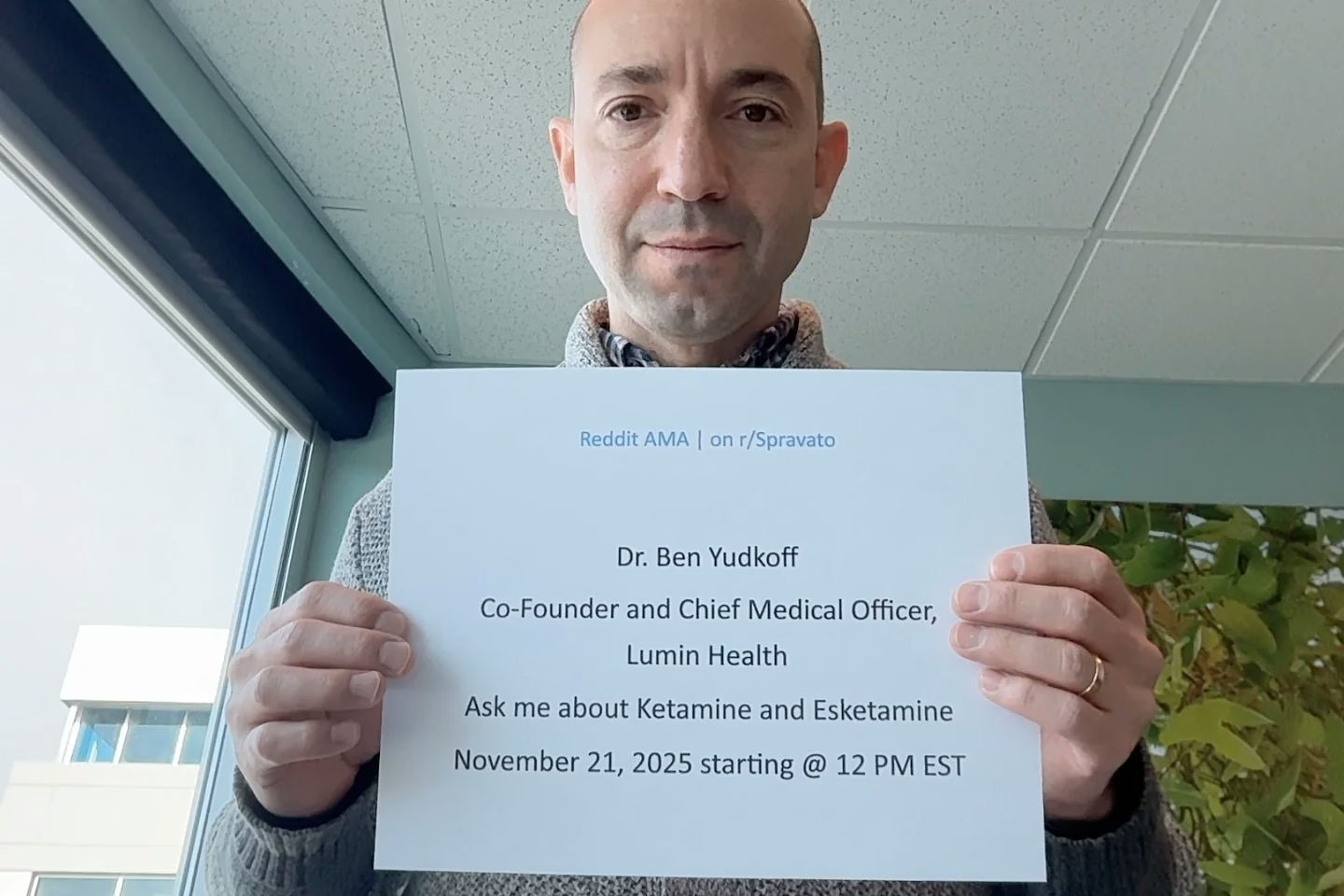
Dr. Ben Yudkoff, Co-Founder and Chief Medical Officer at Lumin Health, hosted a Reddit AMA on the Spravato community on November 21, 2025. The below blog post is a recap of one of the questions presented on that AMA, syndicated to the Lumin Health blog in the event that it answers any questions about ketamine therapy, Spravato treatment, or general concerns you may have about treatment.
Read the full AMA on r/Spravato here
Don’t hesitate to get in touch with us if you’re interested in learning more about ketamine for depression at Lumin Health. Thank you once again to the moderators and community members for facilitating such an engaging discussion.
Megantics1 asks:
Thank you for giving your time and expertise to us! I was under the impression that Spravato was a short term treatment. I've had 8 sessions twice a week at 56 mg, and begin 84 mg once a week next Tuesday. I have not had lasting relief, though I've been in group therapy 3 days a week. Only after joining this Reddit group did I learn that this may be a lifelong treatment. I'm also wondering about trauma. I think ketamine was approved for PTSD first, and many in the group with MDD or TRD have shared how helpful Spravato has been for processing trauma that contributes to their diagnosis. How successful is Spravato for TRD, MDD, and SI for patients who are not dealing with trauma?
Answer:
Thanks Megantics. I'm going to try and break down my response into two parts - part a) is running through a typical treatment course; part b) is talking about Spravato and people w/ and w/o trauma.
Part A)
'The original recommendation (2019-Jan 2025)'. for Spravato was to start treatment at 56 mg for the first treatment on day 1 and, if tolerated, increase to 84 mg thereafter. As of Jan 2025 the recommendations have been revised to permit starting at either 56 mg or 84 mg. There's been conflicting opinions on whether either dose is better - meaning more likely to benefit a patient. Initially, the 84 mg pulled ahead statistically. That was challenged in later studies. In my experience, nearly everyone moves to the 84 mg on their second treatment, in line with the recommendation. There are extenuating circumstances. Some people who are highly trepidatious on their first treatment might actually prefer to start at 28 mg (one canister). Some people find that the 56 mg is the sweet spot and really don't need any more. The guidelines are guidelines. One of the pleasures of being a doc in this space is developing a good understanding of the medication (how it works, getting feedback from patients, seeing real world circumstances unfold) and finding those spaces when tailoring the treatment to an individual's needs and journey is a higher priority than just following a roadmap. In your circumstance, one question I'd be asking myself is if the 56 mg has been underdosed (this question would need to be qualified with a deeper understanding of your response and side effects). There's still hope for lasting relief!
Part B)
I'm going to nitpick on language for a hot second - not to be a nudge, but because the terms here are confusing and actually have medical legal implications. The only "approved" use (meaning approved by the FDA) of ketamine is for anesthesia. Ketamine used for psychiatric conditions is an "off label" use -- this means that 'doctors and advanced practice practitioners (NPs and PAs)'. administer this medication for reasons other than what the FDA intends. This happens all the time in medicine. Gabapentin, for example, has an FDA approval for partial seizures, postherpetic neuralgia, and restless legs syndrome, but we prescribe it "off label" in psychiatry for anxiety, insomnia, hot flashes, etc. 'Also, its first use was in depression'. -- there's a great story about a chance encounter between an anesthesiologist and a psychiatric-researcher (Amit Anand, with whom I've had the pleasure of working) in 1999 in which they were discussing how low dose ketamine preferentially blocks NMDA receptors with implications for modulating glutamate release. This led Dr. Anand to deliver the first dose of ketamine to a patient with suicidal thoughts, culminating in what might be the most important paper published - really the first that changed our thinking about ketamine - in 2000. A good conversation on a train to work led to the discovery of a life changing use of ketamine! I hope you find this interesting... it's a weird world out there with so many terms having cross over usage. As I work in this space I'm extremely careful about language because, as we're standing out in the front of a new way of treating - a new way that also challenges existing frameworks of what medicine can be - I keep myself firmly planted in the medical-legal system so as not to offend...
Spravato has an FDA indication (meaning it was approved for use by the FDA) 'for Treatment Refractory Major Depressive Disorder (defined by Janssen…'. - the company that makes Spravato - as inadequate response to 2+ antidepressants, but defined very differently by different insurance companies, making the process of getting approval for treatment a little complicated) and Major Depressive Disorder with suicidal thoughts with intent (seems straightforward, but here, too, the insurance companies define this differently).
Now let's get to the meat of your question: Janssen studied Spravato's use purely in the context of Major Depressive Disorder and the results they provide can only be extrapolated onto its efficacy in Major Depressive Disorder. This is confusing as so much literature about ketamine is about PTSD. It gets more complicated when, in the real world, there are two broad categories of PTSD: acute PTSD and chronic/complex PTSD.
To make this response less rambly: 60% of people (roughly) who try Spravato, irrespective of how many antidepressant treatments have been tried previously, will find benefit (roughly 1/3 will experience remission, 2/3 will experience improvement). These numbers apply *only* to people with treatment refractory MDD. The question about MDD and SI is really complicated but boils down to roughly half of people with MDD and SI with intent will experience benefit from Spravato.
You've read the science. Now take the next step.
Lumin Health provides safe, expert-administered ketamine and Spravato treatment across Massachusetts and the greater Washington DC/Maryland area. Your journey starts with a free, no-commitment intro call.
Available in Massachusetts and the greater Washington DC/Maryland area.