


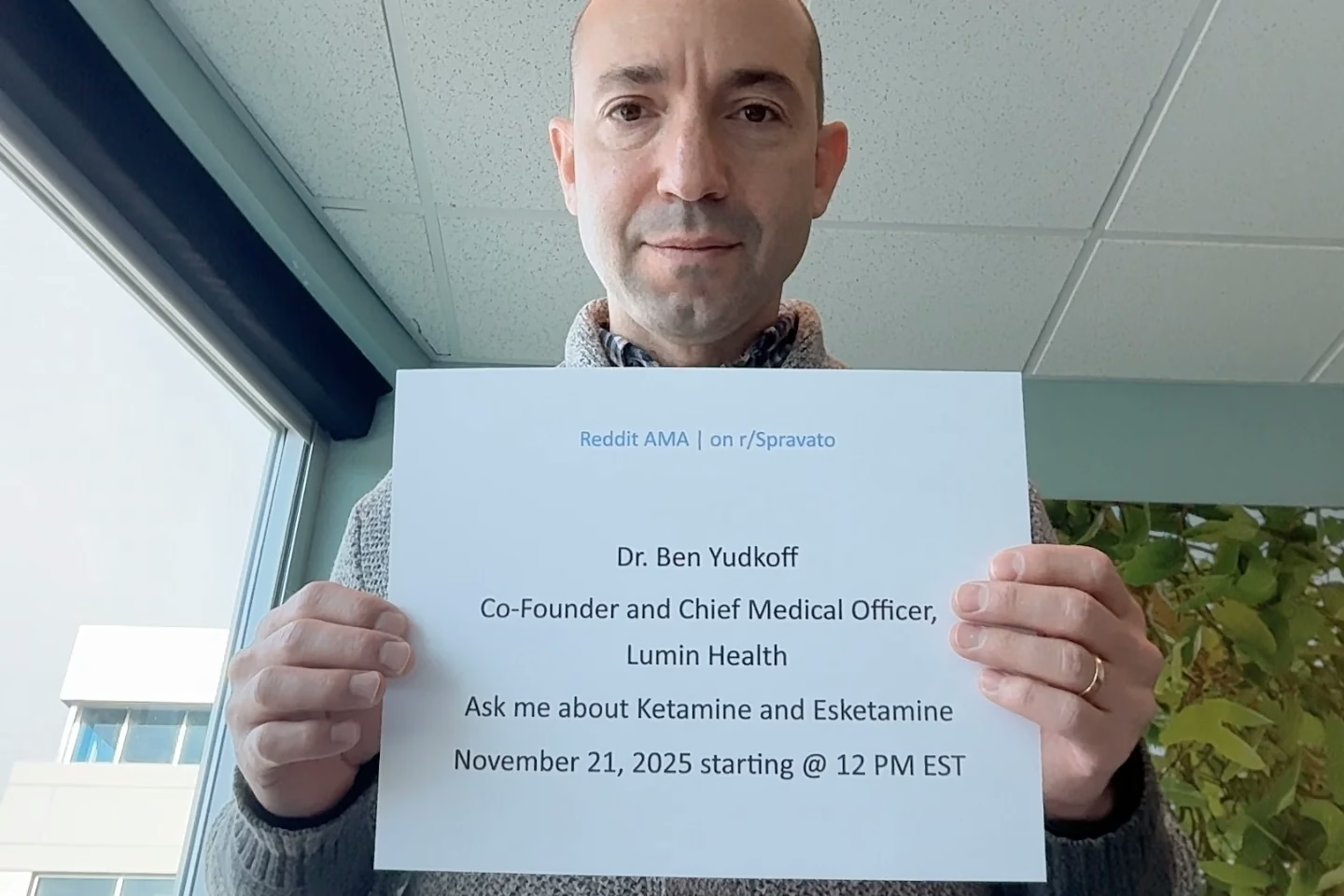
Dr. Ben Yudkoff, Co-Founder and Chief Medical Officer at Lumin Health, hosted a Reddit AMA on the Spravato community on November 21, 2025. The below blog post is a recap of one of the questions presented on that AMA, syndicated to the Lumin Health blog in the event that it answers any questions about ketamine therapy, Spravato treatment, or general concerns you may have about treatment.
Read the full AMA on r/Spravato here
Don’t hesitate to get in touch with us if you’re interested in learning more about ketamine for depression at Lumin Health. Thank you once again to the moderators and community members for facilitating such an engaging discussion.
Live2sk888 asks:
Hello! I am almost 3 months in with my Spravato treatment. It is definitely helping my depression. I am a strange case because I am a minimal or non-responder to almost all meds (including cannabis, psilocybin, even have a high tolerance for alcohol and I almost never drink). I have taken 20-30 different antidepressants and psych meds over the last 30 years. The few things that did help have always stopped working after 3-4 months, so I am nervous this will also.
My main questions are:
- After dropping from twice a week to once a week, I feel like my progress stopped and now I'm just barely maintaining the progress from the first month. My clinic isn't really wanting to see if I can get approved to go back to twice a week. Do you think doing that would be worthwhile?
- A few years ago I did a series of 6 IV ketamine treatments. It did not produce any noticeable results, and the dissociation/"trip" effects during those were not nearly as strong as with Spravato. Everyone tells me that is basically impossible because the IV is "so much better". Do you have any idea why this might be the case? Spravato hits me quite hard during my sessions (in a good way!), and If quotes are being cleaned up, change to 'it's puzzling to me'; otherwise leave as a preserved third-party quote. that this is the one thing I seem to react strongly to.
- If I am unable to go back to twice a week with Spravato, do you think I might benefit from switching to another method of Ketamine treatment at home that I can do more often? I've heard those options (like troches and IM injections) are not as good as Spravato. I also had troches for a month or 2 in the past (provided after completing the IV sessions) and they did virtually nothing, but I think the dose was super low.
And finally, thank you so much for giving your valuable time to help us here!!!!
Answer:
Thank you for the question, Live!
Some people notice that a higher frequency of treatments are helpful, but so far as I know, insurance has not covered perpetual twice weekly treatments - that's the first hurdle to cross when considering the Spravato regimen. The other thing is safety. Spravato (or really any ketamine product) when taken regularly can increase the likelihood of causing something called ulcerative cystitis. This is where ketamine and its breakdown products can irritate the lining of the bladder. And so while we generally don't see ulcerative cystitis occurring as a side effect from Spravato (because the frequency is low/modest), increasing the frequency of Spravato might make this side effect more likely and it's definitely worth a conversation with your providers as to the relative safety of bumping up the frequency. Speak with your clinic, talk with them about what they've seen. It's also possible that, in certain circumstances, adding some additional ketamine on top of the Spravato, for some of the doses, might help you maintain efficacy. This is not mainstream practice but may be helpful when considering that the climate (insurance, safety, standards of practice, etc.) in which Spravato is given has tremendous impact on how Spravato can be offered.
Thank you for your question about IV treatments. Without more information, I'm not sure I can comment on why those IV treatments were not as strong as Spravato. There are many considerations here such as dose, the duration that the IV ketamine was provided, and any associated concomitant medicines taken with the ketamine. These are three front and center factors that could play a role in how strong the experience was. There may be more...
I don't think it's correct that it's impossible that IVs are “so much better,” and that you wouldn't have a stronger effect with Spravato (especially when tuning to other considerations).
The question of switching to another method such as the troche is interesting and one that's come up in some of the other questions in this AMA. There are no head-to-head comparisons that are reliable and strong enough to say that one version of ketamine is declaratively worse or better than another. There's been no study of the efficacy of troches and that relative success compares with Spravato. Generally speaking, troches introduce increased variability in how the medication is absorbed. And so while it is true that both Spravato and the troche get absorbed through a type of skin called a "mucous membrane," the parameters of their absorption is quite different. The volume of Spravato that's administered is quite low and so a lot of it can stick to the mucosa (lines the nose and the intended target of Spravato). The troches are quite different: troches have to be held in the mouth and saliva needs to pool to hold it close to the mucous membranes of the mouth. Anytime somebody swallows any ketamine that's swallowed is mostly rendered inactive. When a person expectorates (or "spits out") the troche after treatment even more is lost. There's more variability in terms of what gets delivered - this may ultimately impact efficacy.
For these reasons you might notice that the doses of troches are often significantly higher than the doses associated with an IV ketamine dose or a Spravato dose simply because more of the medicine needs to be delivered to the mouth to reliably get some portion of it into the body. One of the reasons why you may not have had a strong experience or strong recovery from the troches is that the dose may simply have been too low or how you were taught to take the troche may not have adequately tuned to the concerns around absorption.
I'm cautious urging taking ketamine more than once weekly simply because there are risks around developing ulcerative cystitis. And so without knowing more about you and also being mindful of the risks of making blanket statements without knowing more about your particular circumstance, I would generally fall back to a conservative recommendation of not necessarily taking ketamine twice weekly in any formulation as a platform recommendation. I think that conservative approach can be modulated with a conversation about any potential extenuating risks that would predispose you to ulcerative cystitis, a conversation with you about what ulcerative cystitis is to make sure that you had proper informed consent, and a general discussion about making sure that risks of more regular taking of ketamine (specifically risks of habituating to the medicine and getting tolerance) would also be addressed in a treatment plan period.
Find out if ketamine therapy is covered by your plan.
Lumin Health accepts most major insurance providers for Spravato treatment in Massachusetts and the greater Washington DC/Maryland area. Use our free tool to check your coverage instantly — no forms, no phone calls.
Available in Massachusetts and the greater Washington DC/Maryland area.