

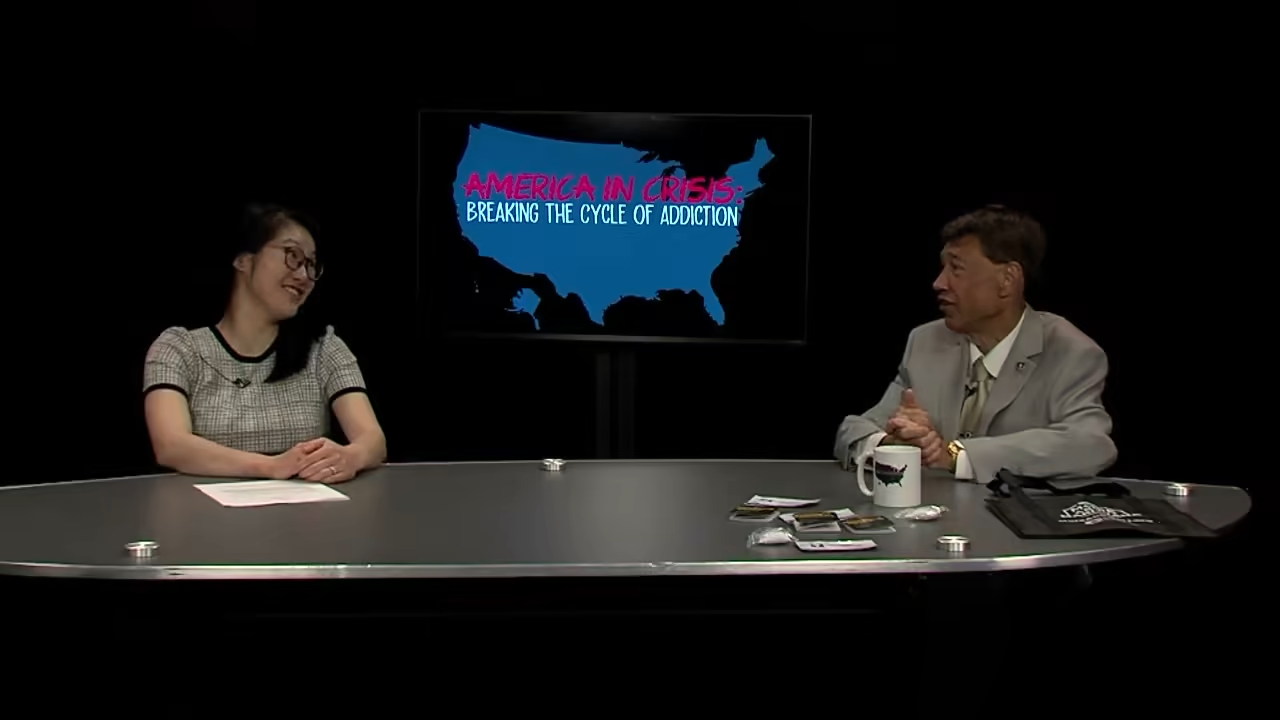
On Episode 47 of America in Crisis: Breaking the Cycle of Addiction, our Dr. SJ Fletcher, MD PhD sat down with host David Hunt to explain why depression so often drives substance use – and what Spravato (esketamine) actually does to interrupt the cycle. Watch the full episode here.
A Conversation Worth Watching
Episode 47 of America in Crisis is a 45-minute conversation that does something rare: it treats the relationship between depression and substance use with both clinical seriousness and human warmth. Host David Hunt asks the questions a worried family member or a primary care doctor would ask, and Dr. Fletcher answers them the way she would answer a patient sitting across from her – plainly, patiently, and without medical jargon.
From our perspective at Lumin Health, the conversation is worth listening to in full. It is also worth unpacking. What follows is a recap of the moments we found most clinically important, with timestamps so you can jump to each section in the episode.
Open the episode on YouTube and follow along.
"Depression Is a Message From Our Minds and Our Bodies"
Around the 8:25 mark, David Hunt asks a question that every clinician hears in some form: "Why is reaching for alcohol not the best move?" Dr. Fletcher's answer reframes the entire conversation that follows.
"I like to think of depression as a message from our minds and our bodies that we need to take a break. It's sort of like a human version of hibernation. It's when our brains sense that we don't have enough resources – emotional, social, physical – to live the lives we'd like while feeling safe and fulfilled." – Dr. SJ Fletcher
That is not a definition you will find on WebMD. It is a clinician's way of telling a patient that depression is not weakness or a character flaw – it is a signal. And once you hear it that way, the rest of the episode makes sense: people who reach for alcohol or cannabis are not failing; they are trying to silence the signal with whatever is in reach.
She follows the hibernation framing with an analogy that has stayed with our team. Imagine you are gardening, and you get a splinter. The splinter is depression. Instead of pulling it out, you drink enough that you cannot feel it. The pain goes quiet. The splinter is still there, still festering, getting worse. [9:55]
Alcohol, Cannabis, Opioids – A Substance-by-Substance Walkthrough
From around 12:11 through 18:00, Dr. Fletcher walks David through the three substances most often used to self-medicate depression. Each gets a careful, non-judgmental answer.
Alcohol. A depressive substance that slows the brain. Helps in the short term, deepens depression and anxiety in the long term. [8:25]
Cannabis. Often assumed to be a benign coping tool now that it is legal in many states. Dr. Fletcher pushes back on that assumption. Cannabis is also a depressive substance. With long-term heavy use it can deepen the same depression people are using it to escape. In young men with underlying vulnerabilities, it can trigger psychosis that does not go away. And – the point we wish more patients heard – cannabis has a real withdrawal syndrome that can last weeks to months, with low mood, anxiety, and insomnia[5,6]. Patients reducing cannabis often mistake withdrawal for proof that they need it. They do not – their nervous system is recalibrating. [13:59]
Opioids. Dr. Fletcher takes the conversation somewhere David steers it: a construction worker who gets hurt at work, takes a prescribed opioid for ninety days, and finds he cannot function when the prescription runs out. Her answer is operational – seek a clinician who can help you come off in a safe way, because the brain's opioid receptors have reset, and managing that reset on your own is dangerous. [15:20]
For patients curious about how these substances interact with esketamine and ketamine, our deeper write-up on ketamine and common drug interactions covers the pharmacology.
The Default Mode Network – and What Spravato Is Actually Doing
Around 20:25, the episode pivots from what's making this worse to what can actually treat the underlying depression. This is where Dr. Fletcher introduces Spravato (esketamine) and the science behind it.
Two mechanisms matter, and the episode covers both. The first is brain flexibility. Antidepressants increase the brain's capacity to form new connections, and Spravato's action on the glutamate system does this in a more direct way than classic SSRIs.[1] The second is the default mode network – the circuitry that comes online when we are not actively doing anything.
For people with depression, that network becomes overactive and rigid. It traps people in cycles of rumination, hopelessness, and negative self-perception. Thought patterns and behavioral patterns – entrained in white matter tracts in other parts of the brain – become inflexible. Reward circuits are skewed. Futility is, in a real sense, hard-coded.
Spravato turns the volume down on that network and creates the space for new patterns to form. As Lumin Health's Chief Medical Officer, Dr. Ben Yudkoff adds one piece the episode does not have time for: ... (or change the post byline to Dr. Ben Yudkoff): ketamine also appears to repopulate mu-opioid receptors on the surface of brain cells, sensitizing them to naturally occurring endorphins[2] – the chemistry behind sensations like a runner's high. It is mechanistically distinct from how opioid medications work, and it is part of why ketamine and esketamine therapy changes how the brain registers hopelessness.
Dr. Fletcher offers a simpler image for all of it at 30:25:
"Imagine you're riding a rusty bike. The depression is the rust. You're doing all of this work, and most of the work you're putting into pedaling this rusty bike is going against fighting that rust. Ketamine – all it is – is a little bit of oil on the rusty gears. You're still having to work really hard. But as you pedal more and more, more of the oil gets in, some of the rust flakes off, and it gets easier and easier to pedal to get where you want in life." – Dr. SJ Fletcher
"No Magic Pill" – How Treatment Actually Works at Lumin Health
One of the most important moments in the episode comes around 33:50, when David asks if Spravato is essentially a magic pill. Dr. Fletcher does not soften the answer:
"I say to patients when they come in, 'Are you looking for a medicine that will just change your life and make you magically better?' I wish I had that magic pill. But this medicine and all medicines work for people who are ready to make a change in their lives." – Dr. SJ Fletcher
The treatment is structured. From 28:42, Dr. Fletcher walks David through the first hour-long evaluation: full psychiatric and medical history, current medications, prior treatment history, goals. From there, Spravato runs on an eight-week induction protocol – twice a week for four weeks, then once a week for four weeks.[3] After eight weeks, the patient and the psychiatrist look at where things stand and decide what comes next.
Most patients begin to notice something different in the first two to four weeks. By six to eight weeks, the changes are usually more visible – "the things that used to get to me don't get to me as much, and I feel like I can just do things," as Dr. Fletcher describes it. [37:50]
Each session is about two hours from check-in to leaving the door, with the active phase of the medication lasting roughly forty minutes.[4] [40:21] Patients arrange a ride home. Safety is built into the protocol – vital signs, monitoring, a comfortable recliner with dimmable lighting, eye masks, noise-cancelling headphones for music.
Access – How Patients Actually Get In
Toward the end of the conversation, David asks the question every patient quietly wants the answer to: "How do you get paid? Do you take insurance, MassHealth, or do I have to pay cash?" [43:58]
Dr. Fletcher's answer:
"The fundamental thing about Lumin Health is we want to make it as accessible for everyone. We operate mostly through insurance. About 99% of patients I see use insurance for this Spravato treatment." – Dr. SJ Fletcher
Spravato is FDA-approved for treatment-resistant depression[3], and insurance companies apply their own criteria when authorizing it. Navigating that authorization is part of what our intake team does. You can see the plans we accept on our insurance page.
Watch the Full Episode
The recap above hits the moments we found most clinically valuable, but the conversation is worth the full forty-five minutes. David Hunt asks Dr. Fletcher about PTSD, OCD, anxiety, adverse childhood experiences, and what the treatment room actually looks like – pieces we did not have space to cover here.
And the closing line of the episode is the one we want to leave you with. From around 45:14:
"It's so easy to suffer alone, but you don't need to. There are so many people who care. We would love to have you come in and for us to help you rather than you suffer alone. So please reach out." – Dr. SJ Fletcher
If you have been carrying something heavy for a long time, we would be grateful to walk with you. Learn more about Spravato treatment at Lumin Health.
Frequently Asked Questions
Where can I watch Episode 47 of America in Crisis?
The full episode is on YouTube: America in Crisis: Breaking the Cycle of Addiction, Episode 47. The show is produced by Woburn Public Media Center and hosted by David Hunt. The episode runs about 45 minutes.
Who is Dr. SJ Fletcher?
Dr. SJ Fletcher, MD PhD, is the Site Medical Director at Lumin Health Woburn and an Instructor in Psychiatry at Harvard Medical School. She trained at Harvard Medical School and Cambridge Health Alliance, and continues to teach and mentor resident psychiatrists. You can meet our full clinical team on the Lumin Health team page.
What is America in Crisis: Breaking the Cycle of Addiction?
It is a recurring public-affairs program produced by Woburn Public Media Center and hosted by David Hunt. Each episode features a guest working in mental health, addiction recovery, or public safety, and is built to help families, patients, and providers understand what resources are available. The show airs on rotating slots through Woburn Public Media stations and on demand on YouTube.
Does Lumin Health treat substance use disorders directly?
No. Lumin Health treats depression – primarily treatment-resistant depression – using Spravato (esketamine) and ketamine. For patients whose substance use needs dedicated treatment, we coordinate with substance use specialists so both layers of the picture can be addressed.
I drink or use cannabis. Can I still get Spravato treatment?
Usually yes, with an honest clinical conversation and a thoughtful plan for how the two are sequenced. Occasional, moderate use is not a disqualifier. Regular or heavy use is addressed before starting, both for safety and to give the treatment its best chance of working. Learn more about Spravato at Lumin Health or reach out for a one-hour evaluation.
– Dr. Ben Yudkoff, Chief Medical Officer, Lumin Health
References
- Zanos P, Gould TD. Mechanisms of ketamine action as an antidepressant. Mol Psychiatry. 2018;23(4):801-811. PubMed
- Gomes I, Gupta A, Margolis EB, et al. Ketamine and Major Ketamine Metabolites Function as Allosteric Modulators of Opioid Receptors. Mol Pharmacol. 2024;106(5):240-252. PubMed
- Popova V, Daly EJ, Trivedi M, et al. Efficacy and Safety of Flexibly Dosed Esketamine Nasal Spray Combined With a Newly Initiated Oral Antidepressant in Treatment-Resistant Depression: A Randomized Double-Blind Active-Controlled Study. Am J Psychiatry. 2019;176(6):428-438. PubMed
- Peltoniemi MA, Hagelberg NM, Olkkola KT, et al. Ketamine: A Review of Clinical Pharmacokinetics and Pharmacodynamics in Anesthesia and Pain Therapy. Clin Pharmacokinet. 2016;55(9):1059-77. PubMed
- Connor JP, Stjepanović D, Budney AJ, et al. Clinical management of cannabis withdrawal. Addiction. 2022;117(7):2075-2095. PubMed
- Budney AJ, Hughes JR. The cannabis withdrawal syndrome. Curr Opin Psychiatry. 2006;19(3):233-8. PubMed