

A Guide to Novel Treatments for Depression: Understanding Your Options
For individuals navigating complex mental health conditions, ketamine and esketamine represent significant advancements in psychiatric care. These treatments work by targeting glutamate pathways in the brain to foster neuroplasticity, offering a potential path to relief for those who have not found success with traditional antidepressants.
When the Brain Feels "Stuck": The Neurological Basis for Treatment Resistance
For many, chronic depression feels less like simple sadness and more like being stuck in a rigid, repeating loop of negative thought. From a neurological perspective, this experience is often linked to the brain's Default Mode Network (DMN). The DMN is a collection of brain regions that are active when we are at rest—daydreaming, self-reflecting, or thinking about the past and future. If you are experiencing depression, your DMN can become overactive and rigid, reinforcing patterns of rumination and hopelessness.[1]
Traditional antidepressants, like SSRIs, work primarily on monoamine neurotransmitters, consisting of the serotonin, norepinephrine, and dopamine systems and can take weeks or months to show an effect. However, when these don't provide adequate relief, we need a different approach. The goal is to help the brain's innate ability to form new connections and pathways.
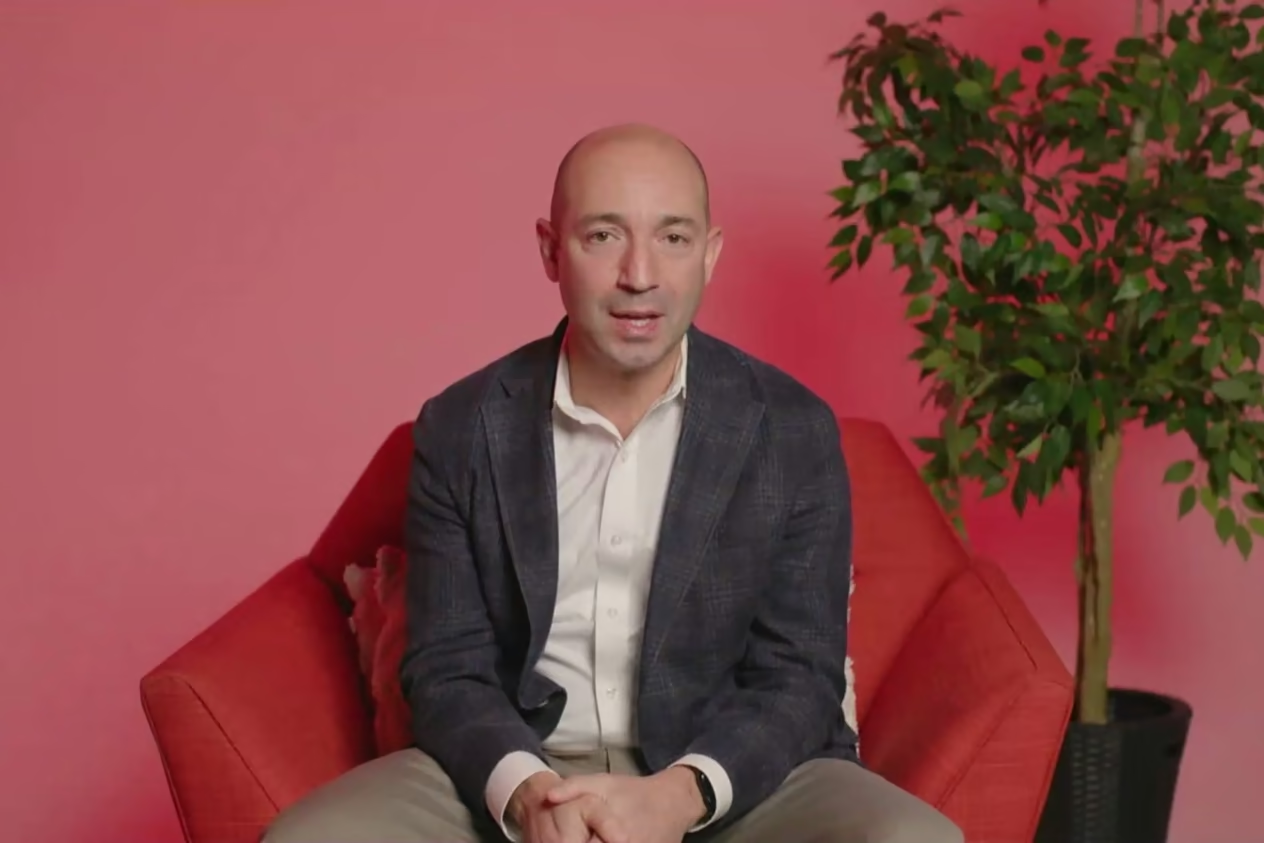
"We don't see these medicines as a standalone fix. We see them as a biological tool to un-stick the brain, creating a temporary state of profound flexibility. Our job at Lumin Health is to provide the clinical support and structure to help patients turn that new flexibility into lasting change."
- Dr. Ben Yudkoff, Chief Medical Officer at Lumin Health
This is where treatments like Spravato and ketamine therapy enter the picture. They work rapidly on a different neurotransmitter system (glutamate) to help "reboot" these stuck circuits, creating a window of opportunity for new, healthier thought patterns to form, especially when paired with behavioral support.
Spravato vs. Ketamine: A Clinical Comparison
While often discussed together, it's clinically essential to understand the distinction between Spravato and ketamine. One is an FDA-approved, highly specific medication, while the other is an evidence-based, off-label application of a medicine that's been used for over 50 years.
Spravato (esketamine) vs. IV ketamine therapy
(Lumin Health provides intramuscular (IM) ketamine, not IV. The comparison below describes the broader treatment landscape.)
• FDA Approval Status: Spravato — FDA-approved for adults with treatment-resistant depression (TRD) and major depression with suicidal thoughts. IV ketamine — used as an "off-label" or "evidence-informed" option for various conditions, including TRD.
• Administration Method: Spravato — self-administered nasal spray under direct medical supervision at a certified site. IV ketamine — administered as a slow, controlled intravenous (IV) infusion by a medical professional.
• Molecular Composition: Spravato — contains only the (S)-enantiomer of the ketamine molecule. IV ketamine — a racemic mixture containing both the (S)- and (R)-enantiomers of the ketamine molecule.[2]
• Clinical Setting: Spravato — must be administered at a REMS-certified practice like Lumin Health, followed by a 2-hour observation period. IV ketamine — administered in a medical setting with continuous vital sign monitoring during the infusion.
A Deeper Look at Each Option
Spravato (esketamine): The FDA-Approved Path
Spravato is the brand name for esketamine, the more active component of ketamine. Its focused FDA approval makes it a critical tool for two specific, difficult-to-treat populations. Research published in the American Journal of Psychiatry further supports its rapid efficacy in treatment-resistant depression.[4] Because it is covered by many insurance plans, it can be a more accessible option for eligible patients. The treatment protocol is standardized, involving a series of sessions at a certified organization where patients are monitored for at least two hours after administration.
Off-Label Ketamine Therapy: An Evidence-Informed Option
Ketamine therapy has been used as an off-label tool for depression for over two decades. A robust body of evidence, including a significant review from the American Psychiatric Association published in JAMA Psychiatry, supports its efficacy. This form of ketamine treatment allows the dose to be adjusted from session to session based on how you respond. While often not covered by insurance, its flexible application makes it a valuable consideration in a comprehensive psychiatric plan.
Addressing Stigma and Common Concerns
It's important to confront misinformation directly. You may have heard ketamine referred to as a "party drug" or even a "horse tranquilizer." It is crucial to understand that the context and dosage determine a substance's effect. In psychiatry the same molecule is used at sub-anesthetic doses chosen for your history, given by a clinician who is monitoring you, in a setting built for it — the dose, the screening beforehand, and the supervision throughout are exactly what separate a treatment from the nickname. Ketamine has been in medical use for more than fifty years.[5]
Concerns about a "bad trip" are also common. At a psychiatrist-led practice like Lumin Health, immense care is taken to manage set and setting. The environment is designed to be calm and safe, and our team is present to provide support throughout the entire experience, minimizing the risk of distress.
A Note for Those Outside Massachusetts
While Lumin Health is a Boston-based organization serving patients across Massachusetts and Maryland, we believe that clear, accurate information should be available to everyone. If you are exploring a ketamine treatment or Spravato outside of our region, we hope this guide serves as a valuable resource for asking informed questions and understanding what to look for in a reputable, safety-focused center.
Your Path Towards Meaningful Relief
Choosing to explore advanced psychiatric care is a significant step. It reflects a deep commitment to your well-being. At Lumin Health, led by an academically-affiliated leadership team, we prioritize patient safety, education, and personalized care over volume. We move beyond the impersonal feel of a large hospital system to create a space specially tailored to the ketamine/esketamine experience and to the needs of our specific patients. If you are exploring whether this may be a fit for you or a loved one, we are here to provide clear, compassionate information. We would be grateful to walk with you towards relief.
References
- Evans JW, Szczepanik J, Brutsché N, et al. Default Mode Connectivity in Major Depressive Disorder Measured Up to 10 Days After Ketamine Administration. Biol Psychiatry. 2018;84(8):582-590. PubMed
- Jelen LA, Young AH, Stone JM. Ketamine: A tale of two enantiomers. J Psychopharmacol. 2021;35(2):109-123. PubMed
- Berlim MT, Turecki G. Definition, assessment, and staging of treatment-resistant refractory major depression: a review of current concepts and methods. Can J Psychiatry. 2007;52(1):46-54. PubMed
- Popova V, Daly EJ, Trivedi M, et al. Efficacy and Safety of Flexibly Dosed Esketamine Nasal Spray Combined With a Newly Initiated Oral Antidepressant in Treatment-Resistant Depression: A Randomized Double-Blind Active-Controlled Study. Am J Psychiatry. 2019;176(6):428-438. PubMed
- Domino EF. Taming the ketamine tiger. 1965. Anesthesiology. 2010;113(3):678-84. PubMed
Take the first step today.
If you or a loved one in Massachusetts and the greater Washington DC/Maryland area is struggling with depression or anxiety, Lumin Health's team of experts is ready to help. Book a free 20-minute consultation to learn if ketamine therapy could be the breakthrough you've been looking for.
Available in Massachusetts and the greater Washington DC/Maryland area.
Frequently Asked Questions
What does 'treatment-resistant depression' mean?
Treatment-resistant depression (TRD) is major depressive disorder that hasn't responded adequately to at least two different antidepressant trials, each taken at an adequate dose and duration. Insurers add their own criteria for how TRD is defined and documented. A novel treatment like ketamine or esketamine offers a different mechanism of action if this describes your experience.
Do I need ongoing psychotherapy alongside ketamine or Spravato treatment?
Lumin Health doesn't offer psychotherapy directly, but lasting change is often best supported through psychotherapy with your own therapist or your own self-guided practice. The period of enhanced neuroplasticity after a session is a valuable window for building new coping skills and processing insights. Your care team can help you set goals for that window.
How do Spravato and ketamine therapy work in the brain?
Both act on the brain's glutamate system rather than the serotonin, norepinephrine, and dopamine pathways that standard antidepressants target. This may help loosen rigid circuits tied to rumination and open a window where new, healthier thought patterns can take hold. That window tends to matter most when paired with psychotherapy or your own self-guided practice.
How is Spravato different from off-label ketamine therapy?
Spravato is FDA-approved for adults with treatment-resistant depression and major depression with suicidal thoughts, and it's given as a nasal spray at a certified practice with monitoring for two hours or more. Off-label ketamine therapy has been used for depression for decades and its dose can be adjusted session to session, though it's less often covered by insurance.