

The STAR*D Study’s Sobering Reality and the Neurological Path Forward
The landmark STAR*D study revealed a critical gap in depression care: with each subsequent antidepressant trial, the likelihood of achieving remission drops significantly.[1] This highlights a large population with treatment-resistant depression, for whom standard medications are insufficient and for whom innovative neurological approaches, such as ketamine and esketamine for depression, are essential for finding relief.
For years, the standard approach to depression has been a trial-and-error process with oral antidepressants. Yet, as the Sequenced Treatment Alternatives to Relieve Depression (STAR*D) trial—the largest of its kind—conclusively showed, only about one-third of patients achieve remission with their first medication.[2] With each new medication tried, the odds of success diminish, leaving many feeling hopeless. This isn’t a personal failure; it's a biological reality that points to the limitations of conventional treatments and the need for a different approach to mental wellness.
From "Treatment-Resistant" to "Neurologically Stuck"
The STAR*D findings force us to ask a deeper question: what if the problem isn't just a simple chemical imbalance? What if, after years of persistent depression, the brain's communication patterns have become rigid and stuck in a negative loop?
This is where modern neuroscience provides clarity. We now understand that chronic depression is often associated with dysfunction in specific brain circuits, particularly the Default Mode Network (DMN), which is involved in self-referential thought and rumination. In depression, the DMN can become overactive, locking individuals into cycles of negative thinking.[3] Furthermore, the brain’s ability to form new connections – a process called neuroplasticity – is often impaired.
Dr. Ben Yudkoff, Chief Medical Officer at Lumin Health, explains, “We don’t view the brain as ‘broken,’ but often as ‘stuck.’ The goal of an intervention like ketamine therapy isn't to erase a patient's history, but to fundamentally change their relationship with it. We are aiming to create a temporary state of profound neuroplasticity - a window where the brain is receptive to new patterns, new insights, and the deep work of psychotherapy that follows.”
This "stuck" state is precisely what STAR*D identified. Patients weren't just "resistant" to a medication; their neural hardware was stuck in a pattern that traditional medications struggled to disrupt.
How Ketamine Treatment Addresses the STAR*D Gap
Unlike traditional antidepressants that slowly work on serotonin or norepinephrine over weeks, ketamine and its derivative, esketamine, work on a completely different system: glutamate. Glutamate is the brain's primary excitatory neurotransmitter, and by modulating its activity, these treatments can trigger a rapid cascade of downstream effects, effectively "rebooting" stuck neural circuits.s.
This rapid biological shift is why ketamine for depression can create a receptive window for change, allowing for the difficult but necessary work of behavioral support to take root and create lasting change.
The Clinical Evidence for a New Approach
The evidence supporting this approach, particularly the efficacy of ketamine for depression, is robust and growing, offering a data-driven alternative for the very patients identified in the STAR*D study. The focus is no longer on simply managing symptoms, but on creating the biological conditions for profound and sustained healing.
For example, a pivotal study published in The American Journal of Psychiatry demonstrated the rapid and robust antidepressant effects of a single infusion of ketamine, with significant improvements seen in as little as 24 hours.[4] This study was one of many that helped shift the paradigm in psychiatry. Furthermore, the development of Spravato, which is FDA-approved for adults with treatment-resistant depression and major depression with suicidal thoughts, was based on landmark trials. Research published in journals like JAMA Psychiatry showed that when combined with an oral antidepressant, Spravato led to statistically significant improvements in depressive symptoms compared to a placebo.[5] These trials specifically included patients who, like the participants in STAR*D, had failed multiple previous treatments.
At Lumin Health, our psychiatrist-led team works within this evidence-informed framework, providing both off-label IM ketamine treatment and FDA-approved Spravato for appropriate individuals.
A Partner on Your Journey at Lumin Health
The message from the STAR*D study is not one of despair, but one that calls for innovation and personalization in mental health care. For those who feel like they have exhausted all options, it is a reminder that new, evidence-informed paths exist. At Lumin Health, we provide attentive, bespoke care that contrasts with the feeling of being just another number in a large health system.
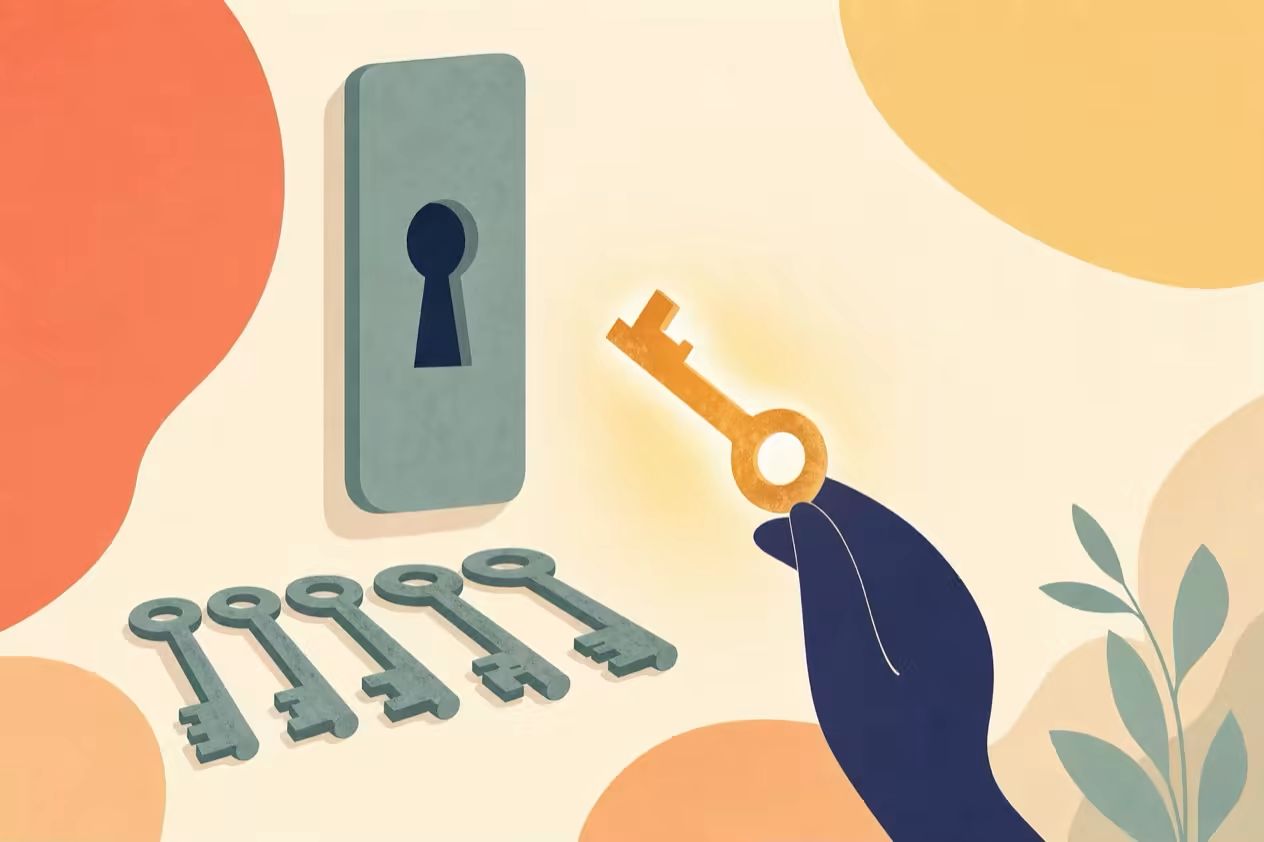
If you have found yourself on a frustrating journey through multiple medication trials, it may not be that you are "resistant" to treatment, but that your brain is "stuck" in a way that requires a different kind of key. Exploring options like ketamine for depression could be that key. We would be grateful to walk with you towards relief and explore whether this may be a fit for your journey.
References
- Gaynes BN, Warden D, Trivedi MH, et al. What did STAR*D teach us? Results from a large-scale, practical, clinical trial for patients with depression. Psychiatr Serv. 2009;60(11):1439-45. PubMed
- Trivedi MH, Rush AJ, Wisniewski SR, et al. Evaluation of outcomes with citalopram for depression using measurement-based care in STAR*D: implications for clinical practice. Am J Psychiatry. 2006;163(1):28-40. PubMed
- Whitfield-Gabrieli S, Ford JM. Default mode network activity and connectivity in psychopathology. Annu Rev Clin Psychol. 2012;8:49-76. PubMed
- Murrough JW, Iosifescu DV, Chang LC, et al. Antidepressant efficacy of ketamine in treatment-resistant major depression: a two-site randomized controlled trial. Am J Psychiatry. 2013;170(10):1134-42. PubMed
- Daly EJ, Singh JB, Fedgchin M, et al. Efficacy and Safety of Intranasal Esketamine Adjunctive to Oral Antidepressant Therapy in Treatment-Resistant Depression: A Randomized Clinical Trial. JAMA Psychiatry. 2018;75(2):139-148. PubMed
Take the first step today.
If you or a loved one in Massachusetts and the greater Washington DC/Maryland area is struggling with depression or anxiety, Lumin Health's team of experts is ready to help. Book a free 20-minute consultation to learn if ketamine therapy could be the breakthrough you've been looking for.
Available in Massachusetts and the greater Washington DC/Maryland area.
Frequently Asked Questions
What is the STAR*D study and why does it matter for depression treatment?
STAR*D was a large clinical trial that found only about one-third of people reach remission with their first antidepressant, and the odds of success go down with each medication tried afterward. This isn't a personal failure; it points to real limits in how well standard antidepressants work for some people. It's part of why researchers began looking at different mechanisms, like ketamine and esketamine (Spravato), for treatment-resistant depression.
Is Spravato the same as ketamine therapy?
No, though they're related. Off-label ketamine treatment typically means intramuscular injections, used for similar conditions. Esketamine (Spravato) is a specific molecule derived from ketamine, given as a nasal spray, and is FDA-approved for adults with treatment-resistant depression and major depression with suicidal thoughts.
Does ketamine or esketamine treatment permanently resolve depression?
No single treatment works as a permanent, one-time solution. These treatments create a temporary window of increased brain flexibility, during which many people find it helpful to pair the medication with psychotherapy or their own self-guided practice. Meaningful relief may be possible, but it takes active participation over time.
Are there fast-acting antidepressant options for treatment-resistant depression?
Yes. Unlike traditional antidepressants that build up over weeks, ketamine and esketamine (Spravato) act on the brain's glutamate system and can show effects much sooner, with some studies reporting improvement within 24 hours. These options are typically considered for treatment-resistant depression, when standard antidepressants haven't provided enough relief.