

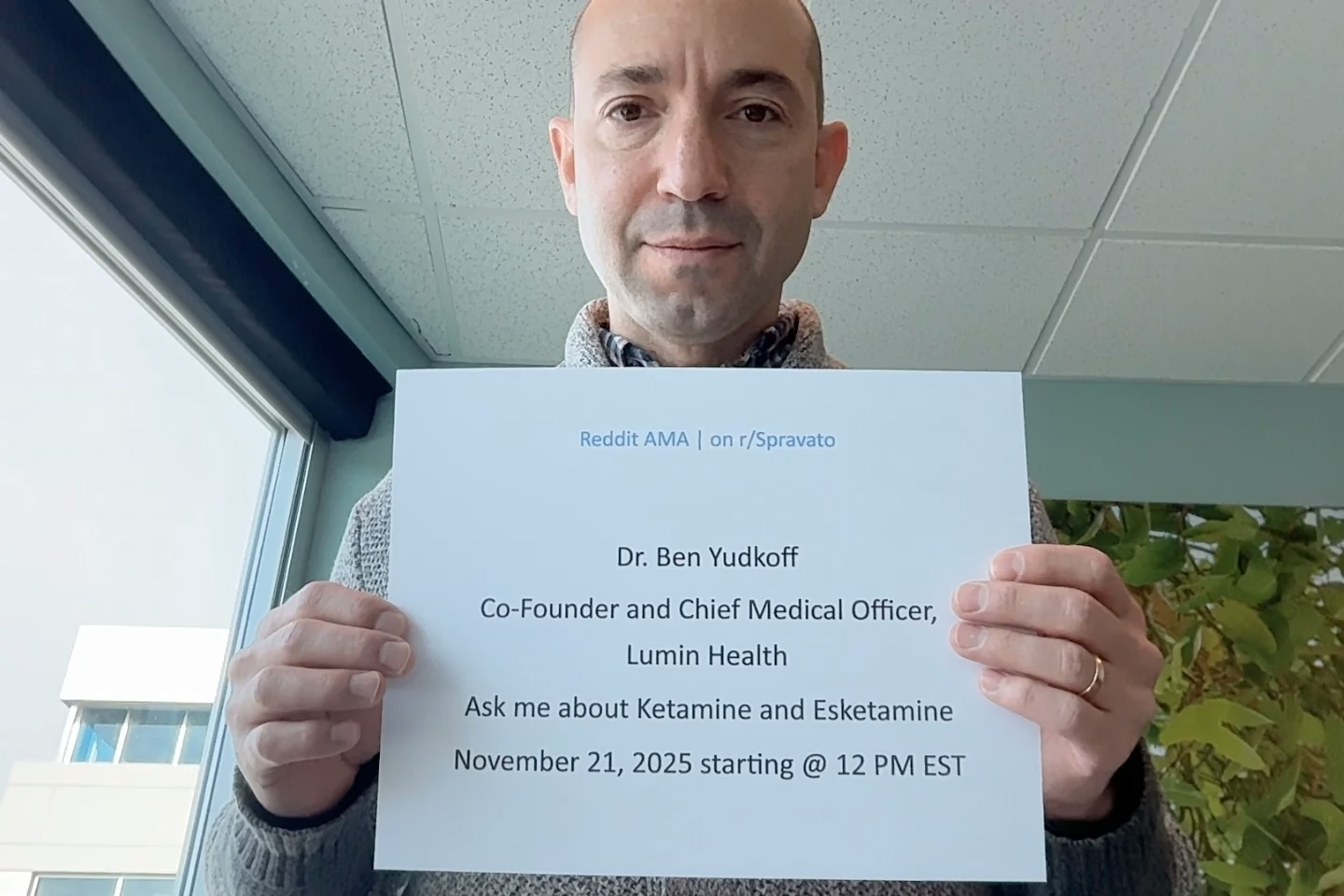
Dr. Ben Yudkoff, Co-Founder and Chief Medical Officer at Lumin Health, hosted a Reddit AMA on the Spravato community on November 21, 2025. The below blog post is a recap of one of the questions presented on that AMA, syndicated to the Lumin Health blog in the event that it answers any questions about ketamine therapy, Spravato treatment, or general concerns you may have about treatment.
Read the full AMA on r/Spravato here
Don’t hesitate to get in touch with us if you’re interested in learning more about ketamine for depression at Lumin Health. Thank you once again to the moderators and community members for facilitating such an engaging discussion.
Then-Campaign9287 asks
What makes Spravato work better? I read drinking grapefruit juice or taking DXM may help. Should we snort it as hard as we can so it goes deeper into our nasal passages and into the throat?
Answer:
There are some things that anecdotally help Spravato work better. Getting a good night's sleep is important. Being able to have a little bit of space before the appointment just to relax your way into it can help the experience feels better. Not having something bookended on the back end of the experience so a person doesn't have to rush back into the regular world but can take some time to think is also important. Listening to music can help the experience feel better. Basically, anything (within reason) that can help an experience feel better can potentially help the medicine work better.
As far as taking other things like grapefruit juice or dexomorphan -- I would urge strong caution. As regards grapefruit juice, the direction of how grapefruit juice might impact esketamine is pretty clear: it inhibits the enzymes that are used to degrade esketamine, but the extent to which blocking this enzyme, alone, and how blocking this enzyme could impact levels of other medications makes it a risky move. I would also urge caution on using dextromethorphan (DXM) - DXM is a common medicine in cough syrups and is also found in the antidepressant Auvelity (packaged with bupropion which - interestingly, is only there to inhibit the enzymatic degradation of DXM!). DXM impacts some of the same receptors that ketamine and esketamine impact, specifically the NMDA receptor. The relationship of DXM with Spravato is complicated and the implications of combining them is not at all clear. In addition, the risks of sedation (among others) would be compounded. Best not to ring more from Spravato by combining it with grapefruit juice or DXM.
One thing that I've anecdotally found in the practice in which I work that helps Spravato work better is providing small doses of additional ketamine on top of the Spravato (controlled and measured, in person, in a medical practice, monitored -- i.e., done safely!). Let's dig in: Spravato is designed to provide a serum concentration equivalent to 0.2 mg/kg of IV ketamine delivered over 40 minutes. This is generally on the lower side. While lots of people do respond to this Spravato dose there are those who simply need a higher dose to experience efficacy. One of the questions that comes up is if Spravato isn't working, is "is it simply that the mechanism of action that Spravato has is not effective for that person, or is it a matter of dosing?" If it is a matter of dosing, carefully monitored additional ketamine (delivered in a way to enhance predictability and mitigate risk). This potential workaround is important when considering that the dose range of Spravato is relatively narrow (56 mg or 84 mg) - this limits the extent to which dosing can be tailored to the individual and is attributable to the high cost of medicine. Ketamine, on the other hand, is much more readily available because of its lower relative cost and can be used to explore questions related to dosing. Importantly, not all medical practices are comfortable with this and a good conversation with providers in an individual practice can help sort the comfort levels of the practitioners there.
Now, the Strength of the Snort: that's a great question. The bioavailability - a term meant to describe how much of the medicine actually makes it into our system - of Spravato is somewhere between 40 to 60%. A lot of that variability is attributable to what happens after the medication is insufflated (the medical term for snorting!). If any of the medication leaks out of our nose it is lost to the body. If we swallow any of the medicine it is essentially degraded before it hits our general bloodstream, and it is basically lost to the body. The goal here is to mist as much of that medicine onto what's called "mucous membranes" of our sinuses. Mucous membranes are the pink skin that lines... that lines the inner lining of our nose. You can do that in a few ways. Typically, I instruct people to tilt their head back about 45 degrees, insert the insufflation device (the cannister), aim it somewhat toward the back of the eye, and breathe in gently as if smelling a flower. This helps target the medicine to the sinus cavity without breathing in so deeply that it hits the back of the nose and drips down the through. Now, some people because of the morphology of their sinus passageways or just something having to do with the process have a harder time with that. In those circumstances, I typically ask that people snort the medicine quite vigorously with the hope that some of the mist totally bypasses the nose, the sinuses, and the nasopharynx (the area that connects our nose and our throat), and gets into our lungs and can be absorbed directly into the blood stream from there.
You've read the science. Now take the next step.
Lumin Health provides safe, expert-administered ketamine and Spravato treatment across Massachusetts and the greater Washington DC/Maryland area. Your journey starts with a free, no-commitment intro call.
Available in Massachusetts and the greater Washington DC/Maryland area.