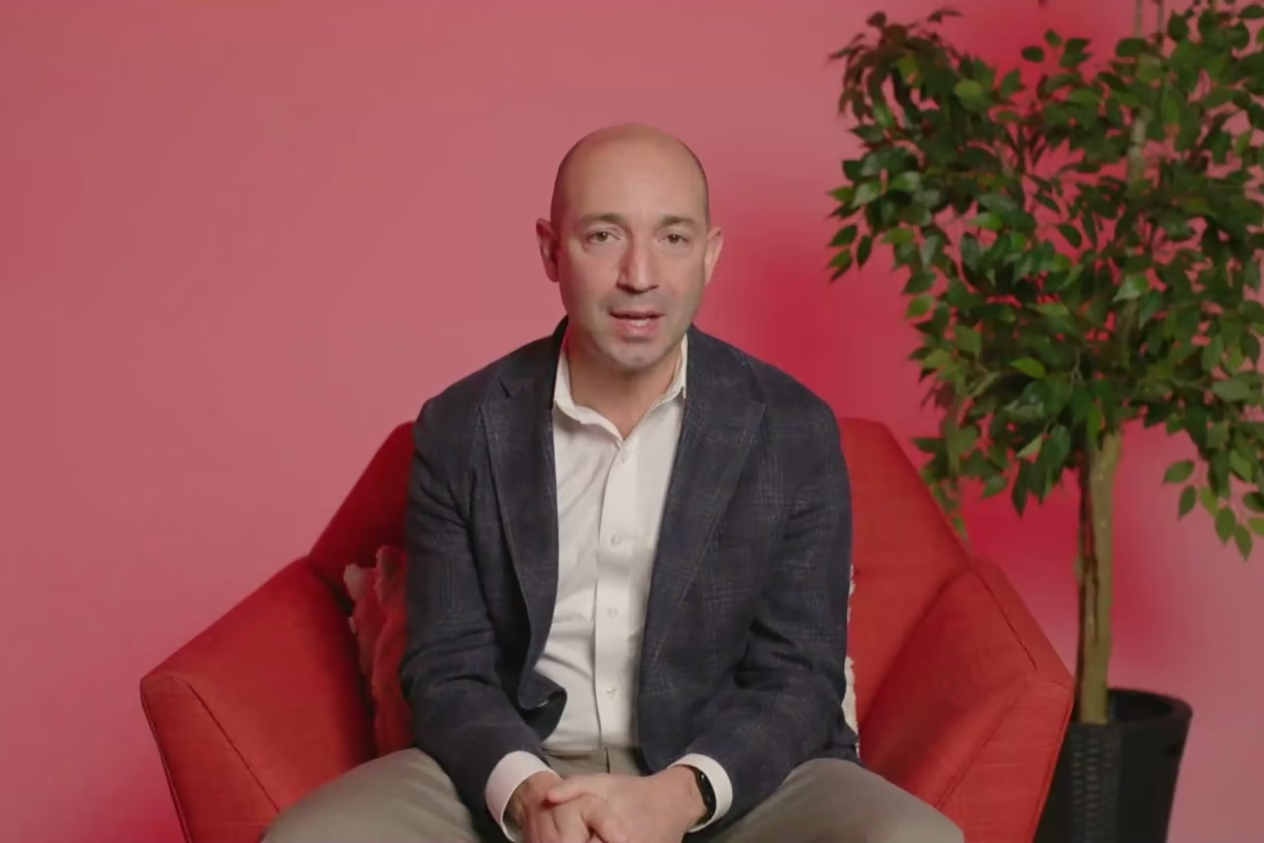


Dr. Ben Yudkoff, Co-Founder and Chief Medical Officer at Lumin Health, hosted a Reddit AMA on r/TherapeuticKetamine community on March 6th, 2026. The below blog post is a recap of one of the questions presented on that AMA, syndicated to the Lumin Health blog in the event that it answers any questions about ketamine therapy, Spravato treatment, or general concerns you may have about treatment.
Read the original Reddit AMA here
Don’t hesitate to get in touch with us if you’re interested in learning more about ketamine for depression at Lumin Health. Thank you once again to the moderators and community members for facilitating such an engaging discussion.
QuitInevitable 915 asks:
What maintenance protocol do you recommend people after the initial loading phase?
Answer from Dr. Ben Yudkoff, Co-Founder and Chief Medical Officer of Lumin Health:
You're asking the right question, one that’s a little difficult to answer as everyone’s trajectory is so different. I think you’re referencing ketamine treatment (as opposed to esketamine treatment) and I’ll keep my answer to ketamine. If you’d like more info on esketamine, please let me know… Most people begin ketamine treatment at 0.5 milligrams per kilogram (with subsequent changes in dose made on an as needed basis). There are permutations of a person's individual case where that might not be the standard initial dose. Usually in my practice and at Lumin Health, we recommend that people persist in the initial phase, for somewhere between 6 to 10 treatments, often delivered twice weekly.
What I recommend personally to people after the loading dose is to engage some of the uncertainty. There are 2 different models of planning for a response to an initial loading phase (what we call the ‘index course’ – that initial 6 entry treatments).
- 1. The first response is to be highly prescriptive about it and recommend, after the index course, a tapering course going from twice weekly to once weekly, then every other week or some permutation of that, then perhaps once monthly, which is built off of other models of interventional psychiatry and standard tapering courses. There are other places that say that after your initial phase of treatment, a person should persist with once monthly treatment for boosters as prophylaxis. The FDA has a written guideline for Spravato for example – that administrators like to follow as closely as possible – that is sometimes used when administering ketamine that follows these guidelines.
- 2. For ketamine which has a little more flexibility in terms of dosing amounts and schedule, I'm in favour of a different course, which is, first and foremost, listening to what the patient's wishes are and how they want to meet treatment. There's a little bit of a gray zone when it comes to the evidence, and so a lot of the planning around this has to do with a patient's wishes, how planful they are versus how improvisational we are, and also what they've budgeted in terms of the treatments. Because ketamine is typically out of pocket, I tend to be more conservative with recommendations to make sure people aren’t spending unnecessarily or being taken advantage of. Usually I recommend that people pause treatment for around a month after the initial phase and take some time to assess efficacy, see for how long the improvement lasts. I tend to follow a more improvised approach: how long does the benefit last, is there regularity in the return of symptoms, and build a follow up protocol based on that. That said, many of the patients I’ve been lucky enough to treat prefer to, anticipatorily, have a set maintenance schedule to protect against a return of symptoms. Most usually, in this particular circumstance, I start out recommending monthly treatments and then to increase/decrease the frequency of response once we have a little more evidence of how the treatments are going.
A quick word on some of the underlying thinking here: Given the high costs of ketamine therapy, we at Lumin Health strongly believe that accessible care requires easy, effective insurance verification and suggesting, if possible, insurance-based treatments, like Spravato. To put this in perspective, in Massachusetts, if someone is eligible for Spravato it can reduce patients’ costs to typically $10 to $25 per visit (a copay, basically), instead of the typical $500+ for a ketamine infusion. Generally speaking (and I’m sure you know this), and speaking specifically of ketamine — careful of practices that rigidly adhere to tapers and maintenance. The decision might be appropriate, but it’s a good idea to ask why they have the plan they do and what evidence they base it on. If you can find less expensive alternatives it’s also worth looking into and working with clinics (if you have them in the area) that can explain the options and justifications between suggesting one treatment vs another.
There isn't a single style approach that fits all circumstances — it’s really a tallying of values and then coming up with a plan. I think the one hazard here for anybody who's considering treatment after the initial loading phase is just making sure that the decisions about what to recommend are not indexed towards the needs of the provider or company at which the person is receiving the treatment – meaning the financial benefits of the company – they should really be evidence-based.
To sum it up: right now, the evidence is gray. I generally recommend a more open ended approach with ketamine to balance the evidence with also the financial ethics of the treatment. I tend to reserve a priori maintenance dosing to those patients who state that they specifically prefer it, and even in those circumstances I work with a person to think of reasonable benchmarks to see how treatment is going and if the plan needs to be modified.
Update From Dr. Yudkoff: How Ketamine Maintenance Tends to Unfold (October 2026)
In a live session for families in October 2026, Dr. Yudkoff returned to this question. His honest starting point: "nobody really knows" in advance what any one person's maintenance will look like. As he put it, "the process of maintenance is really iterative and it usually declares itself."
He described the treatment course in three named phases:
- Index course: about four weeks of twice-weekly treatments.
- Optimization: moving to once-weekly treatment to see how your response holds.
- Maintenance: anything beyond about two months.
From there, people tend to sort themselves. Some notice symptoms creeping back when they miss a treatment and settle into a regular rhythm, weekly or every other week. Others pause on purpose, to see whether the progress they've built through psychotherapy or their own self-guided practice, healthy habits, and life changes holds without the medicine. Some use treatment to get through an acute period and then stop. If stopping predictably brings depression back, an individualized maintenance plan can be built around you.
Dr. Yudkoff also drew a distinction from the research. "Responders," who improve but still carry some symptoms, mostly see symptoms return within about a month of stopping, on average. "Remitters," who become essentially symptom-free, can often go much longer, though studies haven't run long enough to say how long. These are averages, not predictions about you. That's why Lumin Health keeps a safety net in place: if symptoms return after a pause, restarting should be easy.
Take the first step today.
If you or a loved one in Massachusetts and the greater Washington DC/Maryland area is struggling with depression or anxiety, Lumin Health's team of experts is ready to help. Book a free 20-minute consultation to learn if ketamine therapy could be the breakthrough you've been looking for.
Available in Massachusetts and the greater Washington DC/Maryland area.