

Understanding the Interventional Psychiatry Continuum of Care
An interventional psychiatry continuum of care is a structured, psychiatrist-led pathway for individuals with treatment-resistant conditions. It moves beyond a single treatment attempt, creating a personalized sequence of evidence-informed interventions – from neuromodulation to advanced medications – to find a durable path to relief.
For too long, patients with complex mood disorders have felt like a cog in a large, impersonal machine. You try a medication, it fails. You wait months for another appointment, try something else, and the cycle repeats. This fragmented approach often ignores the underlying neurological patterns that keep a person stuck. An intentional continuum of care, like the model we practice at Lumin Health, is the direct antithesis to that experience. It is a thoughtful, collaborative, and responsive journey guided by deep clinical expertise.
The goal is not to simply try random treatments, but to make informed, sequential decisions based on your unique biology and history, creating a responsive partnership on the path toward meaningful relief.
The Neurological Reason for a Stepped Approach: When the Brain is Stuck, Not Broken
The core principle behind interventional psychiatry is a fundamental shift in perspective: your brain isn't broken – it may be stuck. In conditions like severe depression, specific brain circuits can become rigid and overactive. One of the most studied is the Default Mode Network (DMN), a collection of brain regions involved in self-referential thought, or "mind-wandering."
In a healthy state, the DMN allows for reflection and planning. But in depression, it can become a source of persistent, negative rumination. As noted in a foundational study published in the Proceedings of the National Academy of Sciences, hyperactivity in the DMN is strongly correlated with the internal experience of being trapped in negative thought loops[5]. Standard SSRIs don't always effectively modulate this network, which is why a different approach is often necessary.
Interventional treatments are designed to directly target these rigid patterns. They work by creating a state of enhanced neuroplasticity – the brain's innate ability to reorganize itself by forming new neural connections. This biological window of opportunity is the reason a continuum is so critical. The right sequence of treatments can help disrupt old, stuck patterns and then support the brain in building new, healthier ones.
Mapping the Journey: From Neuromodulation to Advanced Therapeutics
At our practice, a patient’s journey is carefully mapped. It often begins with a thorough diagnostic evaluation to understand not just your symptoms, but the full context of your life and treatment history. Based on this, we determine the most appropriate starting point on the continuum.
Advanced Medications for Rapid Relief
When first-line treatments have failed to provide adequate relief, we may look to therapies that work on the glutamate system, which is pivotal for neuroplasticity. This is where options like Spravato and ketamine therapy enter the continuum.
The goal of using a rapid-acting agent like esketamine or ketamine is to quickly create that neuroplastic window, offering a respite from crushing symptoms and creating a biologically receptive state for change.[3]
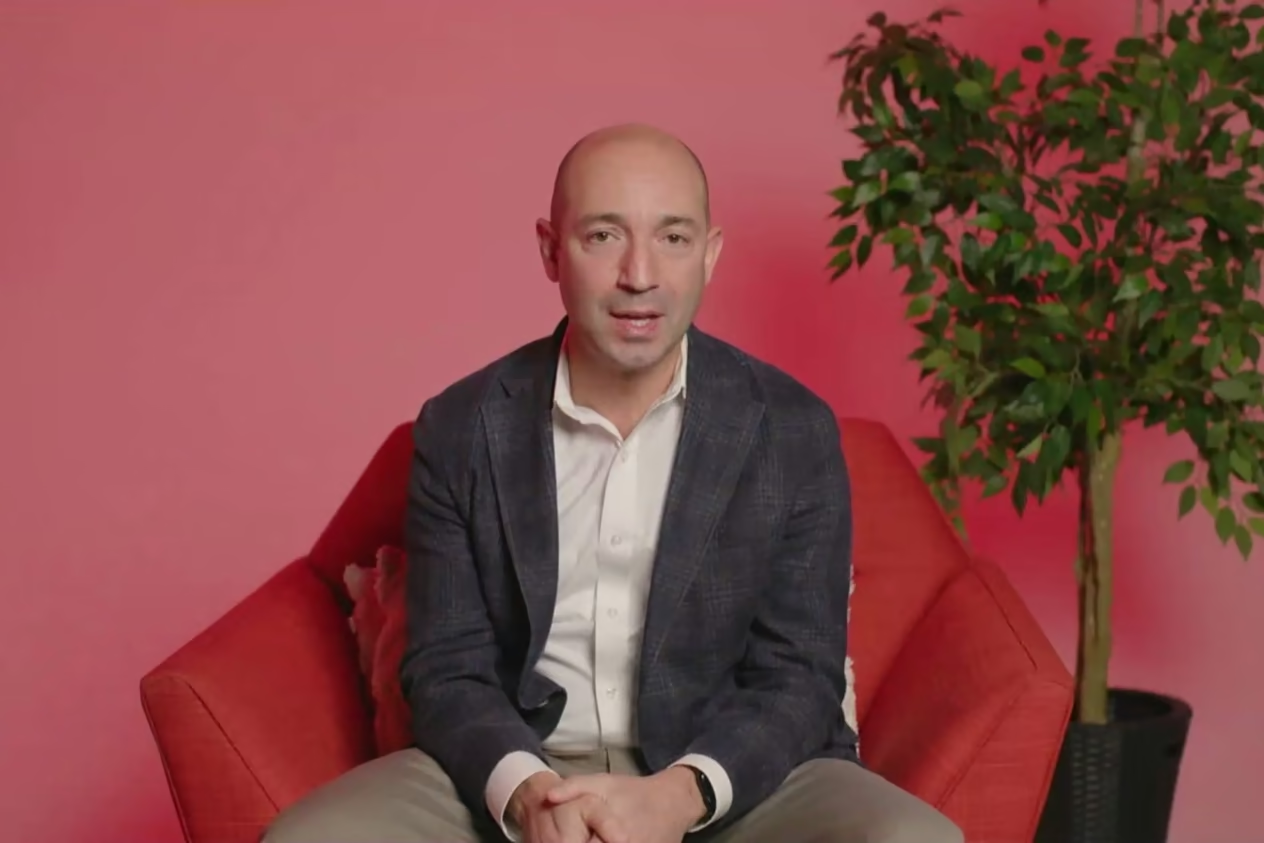
Dr. Ben Yudkoff, Chief Medical Officer at Lumin Health, states, "We are not just administering a molecule; we are creating a therapeutic opportunity. The goal of using ketamine for depression is to disrupt rigid, depressive circuits long enough for the brain to begin exploring new, healthier pathways. The continuum of care ensures we support that process over time."
A key focus of this work is to interrupt the overactive DMN. Research published in The Lancet Psychiatry has shown that ketamine can acutely decrease connectivity within the DMN, which may correlate with the rapid reduction in depressive symptoms many patients experience[6,7].
What This Model Means For You
Embracing a continuum of care means you are no longer a passive recipient of treatment, but an active partner in a dynamic process. It acknowledges that healing is not always a straight line.
"For years, I felt like I was on a conveyor belt of treatments that didn't understand me. At this center, the approach was different. When one thing didn't get me all the way there, it wasn't a failure – it was just data that informed our next step together. It was the first time I felt like a person, not just a diagnosis." – A Patient's Perspective
This journey involves more than just medical procedures. While Lumin Health is a psychiatrist-led medical practice and does not offer psychotherapy, we provide support at our sites. This is designed to help you leverage the periods of increased neuroplasticity to make meaningful changes in your thinking and behavior. We understand many of our patients work independently with their own outside therapists, and our medical care can be a powerful adjunct to that important work.
A Partnership in Your Path to Wellness
Navigating the world of advanced psychiatry can feel overwhelming. The promise of an interventional continuum of care is that you do not have to do it alone. It is a commitment to seeing you through the entire process, adapting the plan as needed, and focusing on the singular goal of durable relief. This personalized, attentive model stands in contrast to the often-impersonal nature of large hospital networks.
While our physical locations are in Massachusetts, we hope this guide provides valuable education for anyone exploring treatment options. For those in our area, if you are looking for a new approach to managing your mental health, we would be grateful to walk with you towards relief. We invite you to learn more about how our approach to treating ketamine for depression and other conditions may be a fit for you.
References
- Popova V, Daly EJ, Trivedi M, et al. Efficacy and Safety of Flexibly Dosed Esketamine Nasal Spray Combined With a Newly Initiated Oral Antidepressant in Treatment-Resistant Depression: A Randomized Double-Blind Active-Controlled Study. Am J Psychiatry. 2019;176(6):428-438. PubMed
- Fu DJ, Ionescu DF, Li X, et al. Esketamine Nasal Spray for Rapid Reduction of Major Depressive Disorder Symptoms in Patients Who Have Active Suicidal Ideation With Intent: Double-Blind, Randomized Study (ASPIRE I). J Clin Psychiatry. 2020;81(3). PubMed
- Zanos P, Gould TD. Mechanisms of ketamine action as an antidepressant. Mol Psychiatry. 2018;23(4):801-811. PubMed
- Loo CK, Gálvez V, O'Keefe E, et al. Placebo-controlled pilot trial testing dose titration and intravenous, intramuscular and subcutaneous routes for ketamine in depression. Acta Psychiatr Scand. 2016;134(1):48-56. PubMed
- Hamilton JP, Farmer M, Fogelman P, et al. Depressive Rumination, the Default-Mode Network, and the Dark Matter of Clinical Neuroscience. Biol Psychiatry. 2015;78(4):224-30. PubMed
- Scheidegger M, Walter M, Lehmann M, et al. Ketamine decreases resting state functional network connectivity in healthy subjects: implications for antidepressant drug action. PLoS One. 2012;7(9):e44799. PubMed
- Abdallah CG, Averill LA, Collins KA, et al. Ketamine Treatment and Global Brain Connectivity in Major Depression. Neuropsychopharmacology. 2017;42(6):1210-1219. PubMed
You've read the science. Now take the next step.
Lumin Health provides safe, expert-administered ketamine and Spravato treatment across Massachusetts and the greater Washington DC/Maryland area. Your journey starts with a free, no-commitment intro call.
Available in Massachusetts and the greater Washington DC/Maryland area.
Frequently Asked Questions
If a treatment doesn't work, am I out of options?
Not at all. An incomplete response to one treatment gives your care team valuable information that helps guide the next step, whether that means a different mechanism of action, a different delivery method, or a combination of approaches. Your psychiatrist-led team works through each decision with you.
Is Spravato the same as ketamine therapy?
No, Spravato is the brand name for esketamine, delivered as an FDA-approved nasal spray for specific depressive disorders. Off-label ketamine therapy uses a different formulation, given intramuscularly at Lumin Health, with its own body of supporting evidence. Your psychiatrist helps decide which pathway fits your clinical profile.
How does neuroplasticity relate to ketamine or Spravato treatment?
Ketamine and Spravato are thought to create a window of enhanced neuroplasticity, meaning the brain's ability to form new connections. This temporary state may help loosen rigid, overactive circuits tied to depression. Your care plan is designed to support your brain in building healthier patterns during that window.
Does Lumin Health offer psychotherapy alongside ketamine or Spravato?
No. Lumin Health is a psychiatrist-led medical practice and doesn't provide psychotherapy in-house. Many patients work independently with their own outside therapists during treatment, and Lumin Health's care can complement that work.