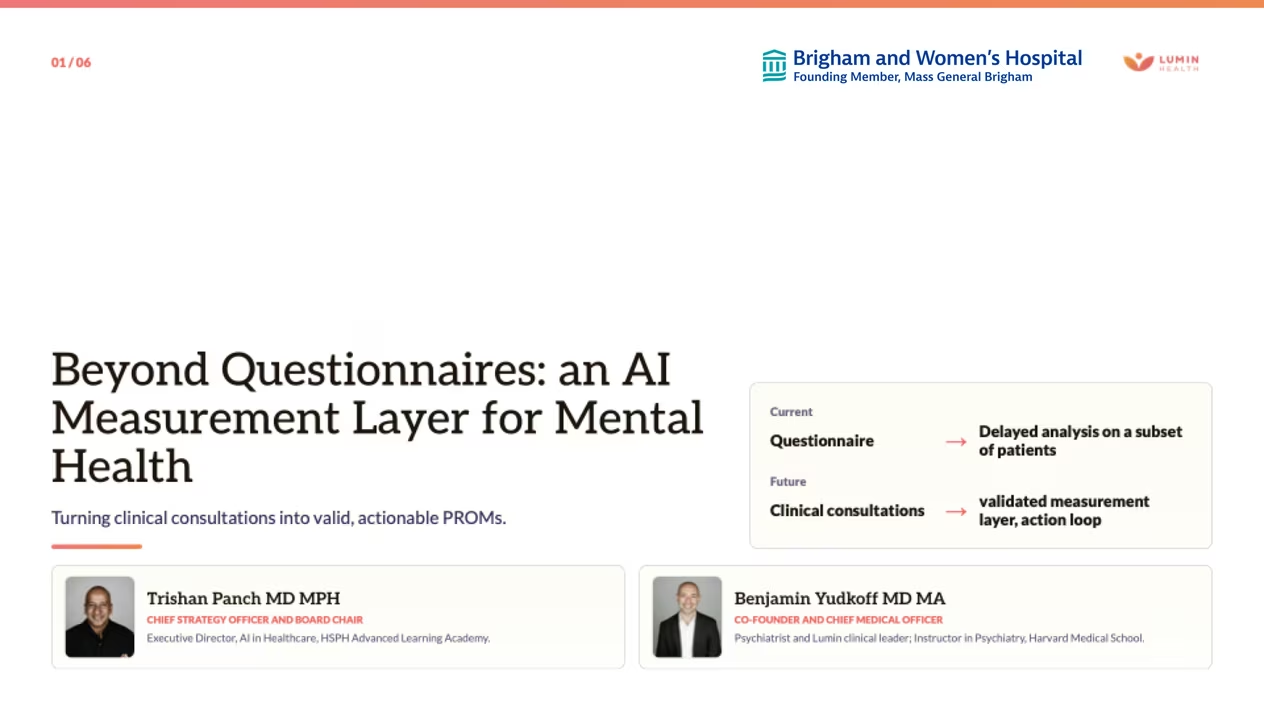


Dr. Ben Yudkoff, Co-Founder and Chief Medical Officer at Lumin Health, hosted a Reddit AMA on r/TherapeuticKetamine community on March 6th, 2026. The below blog post is a recap of one of the questions presented on that AMA, syndicated to the Lumin Health blog in the event that it answers any questions about ketamine therapy, Spravato treatment, or general concerns you may have about treatment.
Read the original Reddit AMA here
Don’t hesitate to get in touch with us if you’re interested in learning more about ketamine for depression at Lumin Health. Thank you once again to the moderators and community members for facilitating such an engaging discussion.
Lilfoodiebooty asks:
What is the industry’s POV on Spravato? The only way I see it changing the game is being able to bill insurance but there are now fewer psychs in my area working around the system and insurance companies. You either have to pay out of pocket for ketamine, go through an online program, or get Spravato.
In my search, many doctors were not impressed with its approval and view it as a cash grab (while all charging thousands for their services).
I see other doctors who used to prescribe compounded ketamine for home use now switching to Spravato, requiring patients to now come into their offices. I find this curious. Patients who were originally able to bill their psychs through their insurance and take their ketamine at home now have to come into the office to continue this treatment.
Is this move simply being done to increase access to ketamine? I’m having a hard time seeing this as something being done for patient choice and more so a move to a more profitable operating model. I have not been able to find a provider who is in network working outside the Spravato REMS program that also prescribes compounded intranasal ketamine for home use. 'My only option so far is to pay out of pocket' (or mark the quote [sic]). for an out-of-network provider or go through online programs, something I do not want to do yet. I am glad I was able to start Spravato but want something that doesn’t tether me to an office once a week for what feels like a lifetime, especially when 'I cannot stomach the thousands it would cost to do anything else' (or mark the quote [sic]).. There used to be more affordable avenues that Spravato may have obliterated for patients looking to be at home.
Answer from Dr. Ben Yudkoff, Co-Founder and Chief Medical Officer of Lumin Health:
Thanks for the questions. By “industry” do you mean the mental health industry? If I’m reading this first part of your question correctly I think it has been mixed, mostly due to the novelty of this kind of treatment (especially its psychoactive properties). Some clinicians – such as myself – approached cautiously and were won over by its efficacy. Some clinicians, especially those who have not had a personal patient success story, encounter the medication with the hesitation that is normal and to be expected when a medication as different as Spravato is introduced – especially when the provision of the medication is usually provided by a different clinician and there could be concerns about the motivations of that clinician. And you are spot on in the second part of your first paragraph: those are the only three clinical ways of obtaining ketamine or Spravato.
As far as the approval process: it is complicated. Some of the initial studies, such as those done with the elderly, did not show that efficacy separated from placebo, but lower doses were used that confounded the information. The statistical analysis of some of the initial studies also warranted further review. Subsequent studies have confirmed efficacy and I don’t think there’s much debate among people continuing to review advances in the literature that the medication has shown a statistically meaningful benefit.
One of the reasons why the medical practice that I co-founded, Lumin Health, is an in-person practice – where Spravato and ketamine are delivered on site – has to do with safety and a general conservative posture (even with a medication that carries the mystical connotation of ketamine and Spravato). I practice in an area hit particularly hard by the opioid epidemic and, in the early days founding Lumin Health, we had meaningful conversations about accessibility vs safety and where we stood as an enterprise. At the time, we felt that there was enough access through take home models that we could establish a more conservative style approach and add other value to the care delivered (to offset some of the nuisances of needing to come to an office to take the medicine).
There are some side effects that need to be monitored. We’ve had a few instances of medical emergencies that occurred in the office that required additional support. We’ve also had some bad trips in which the presence of a clinician was helpful. I also think there is something important (if not inconvenient) in moving into a separate space, a separate ritual, that’s designed around the experience to help give people the freedom to extract from every day of life and dive into the experience. This is why we’ve designed Lumin Health to be conscious of these components; creating a space that feels comfortable, medically rigorous, and inviting in equal measure.
On top of all that, I think we’re all concerned about managing safety around a substance that has ulterior uses and some of the risks introduced in having a more take-home model….
I also think the shift to Spravato has had some benefits: insurance coverage is a big one that we see all the time at Lumin Health across our sites in Massachusetts. The insurance companies won’t cover any take-home doses of any form of ketamine, so having an option that reduces the out-of-pocket costs to just standard office co-pay amounts is a very appealing consideration for someone deciding which treatment to conduct. I also think that the legitimacy that FDA approval lends is appealing, especially for those who might have some nervousness about starting treatment.
'Last but not least, in October 2023 the FDA published…'. something of a letter of warning (https://www.fda.gov/drugs/human-drug-compounding/fda-warns-patients-and-health-care-providers-about-potential-risks-associated-compounded-ketamine) to providers prescribing take-home, compounded ketamine. They did not outlaw it, but the wording of the letter highlights risk and suggests that potential harm that could befall a patient engaging in take home ketamine is well recognized and elevates the liability considerations. That said, as you note in the third part of your question, there may be other reasons to change the style of care to an in-office style. I don’t know much about the financial drivers or other motivating factors involved in the change in practice of some of the providers, but questions around “why it is that things are changing” are totally justified. I’m not sure the decision to move to an in-office model is entirely based on enhancing patient choice – outside of the insurance consideration – and I agree that there are other considerations driving the shift. I hope letting you know a little about my own experience answers some of the questions you may have regarding some of the underlying reasons. I’m sorry it’s been so difficult to secure access to a treatment you find helpful in a treatment-circumstance that runs more in line with what your needs are. 'I sincerely wish you the best and hope you find what you're looking for.'.
Take the first step today.
If you or a loved one in Massachusetts and the greater Washington DC/Maryland area is struggling with depression or anxiety, Lumin Health's team of experts is ready to help. Book a free 20-minute consultation to learn if ketamine therapy could be the breakthrough you've been looking for.
Available in Massachusetts and the greater Washington DC/Maryland area.