


Can Ketamine Be Used for Bipolar Depression?
Ketamine therapy is an off-label option that may be considered for complex depressive episodes when standard treatments have not worked, though it requires careful psychiatric evaluation and ongoing mood stabilizer support.
If you are exploring relief and carry a diagnosis of bipolar disorder, you likely already know the unique weight of depression mixed with the vigilance of monitoring your mood. Most traditional antidepressant research has historically excluded complex mood profiles, and prescribing guidelines are often written with unipolar depression in mind. Your brain isn't broken—it may just be stuck in patterns that have resisted the tools offered so far.
This article aims to provide clarity on the clinical evidence, safety considerations, and the screening logic that determines whether an evidence-based, off-label application of a medicine that's been in use for over 50 years is appropriate for your specific circumstances. Our goal is to give you the clinical framework your next conversation with a psychiatric provider deserves, focusing entirely on your self-guided intent and capacity for meaningful change.
Why Complex Depression Requires Careful Psychiatric Care
Depression within a bipolar framework is neurobiologically complex. Traditional antidepressants act primarily on monoamine neurotransmitters—specifically serotonin, norepinephrine, and dopamine. For individuals with a history of mood elevation, these medications carry a well-documented risk of inducing a manic or hypomanic shift. This is the reason mood disorder guidelines generally recommend relying on mood stabilizers first.
Because traditional antidepressants carry this risk, many patients ask whether ketamine treatment operates differently. At a molecular level, it does. According to a pharmacotherapy review of ketamine and esketamine, this class of medication modulates the glutamate system rather than the monoamine pathways.[1,2] By interacting with the NMDA receptor, it may help the brain form new connections—a state known as neuroplasticity—and quiet the Default Mode Network (DMN), the brain's hub for rigid, self-referential thoughts.[1]
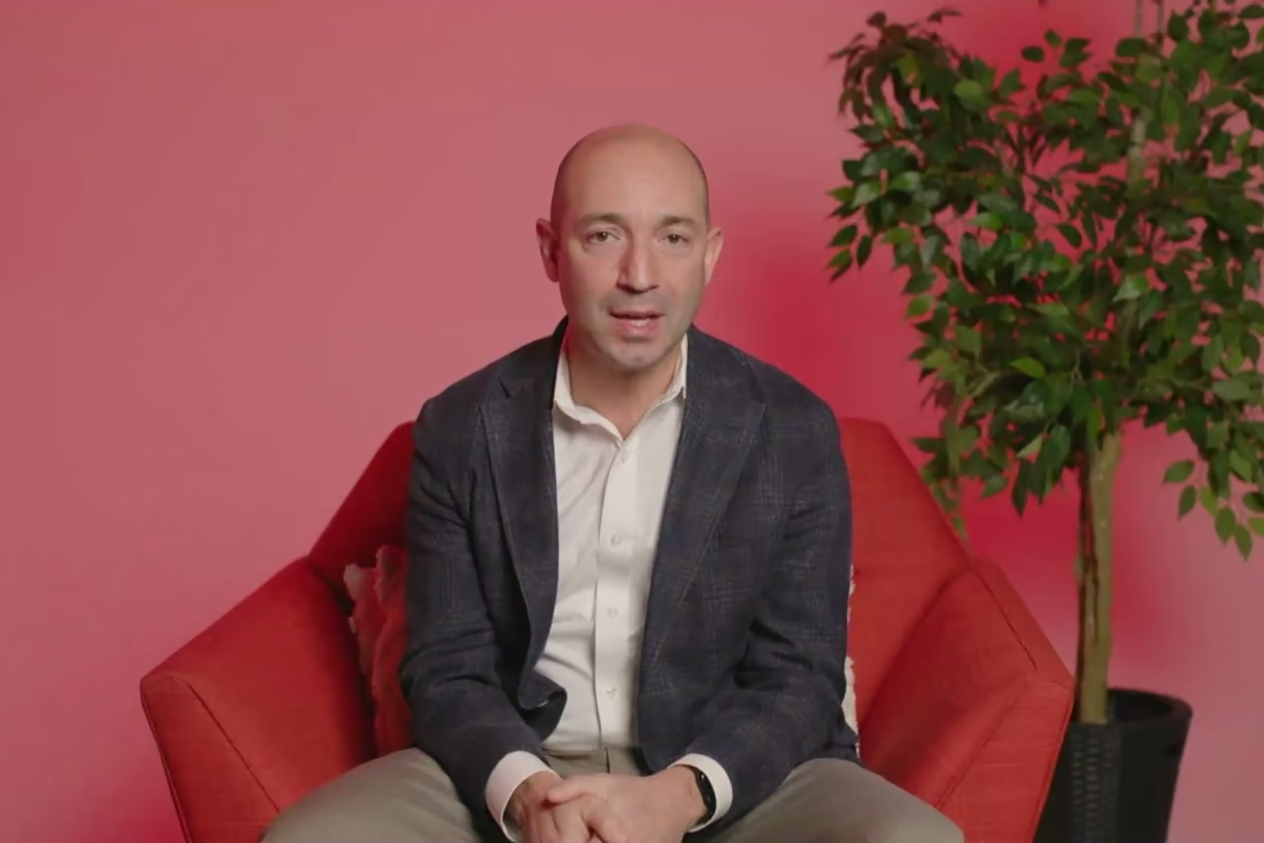
"Treating complex mood disorders demands a highly personalized approach. We carefully balance the potential for rapid relief through neuroplasticity with strict psychiatric safety protocols, ensuring every patient's unique health history guides their care," states Dr. Ben Yudkoff.
While this distinct biological pathway offers a theoretical advantage, the reality is that exploring ketamine for depression requires strict psychiatric care. A comprehensive review of the long-term safety of ketamine and esketamine emphasizes that continuous psychiatric monitoring remains essential, particularly for populations at an elevated risk for mood destabilization.[3] Relief rarely comes from a one-size-fits-all approach; it requires a deep understanding of your personal health history.
How Lumin Health Approaches Treatment
Based out of the Boston Metro area and expanding to other states, Lumin Health is a psychiatrist-led organization committed to providing accessible, evidence-based care. We offer two distinct pathways for patients who have not found relief through conventional medications.
Intramuscular (IM) Ketamine Therapy
For evidence-based, off-label use, Lumin Health provides Intramuscular (IM) ketamine injections, highlighting its benefits such as increased speed and comfort compared to a slow IV infusion. When describing off-label ketamine at a molecular level, it is a racemic mixture containing both the S-ketamine and R-ketamine molecules.[4]
IM ketamine sessions cost $500 per session. Because most commercial insurers do not cover off-label ketamine for mental health, Lumin Health provides a Superbill for patients with out-of-network PPO benefits to submit for potential partial reimbursement.
esketamine (Spravato)
Alternatively, esketamine (Spravato) is FDA-approved for adults with treatment-resistant depression and major depression with suicidal thoughts. At a molecular level, esketamine is the S-enantiomer of ketamine — one of its two mirror-image forms, and the one that binds the NMDA receptor more strongly. The "S" is a chemistry naming convention (from the Latin sinister) describing the arrangement of atoms around the molecule's central carbon, not the direction the molecule faces. Side effect profiles between esketamine and ketamine are largely the same.
esketamine (Spravato) is covered by most major insurers in Massachusetts, including Aetna, Blue Cross Blue Shield, and United Healthcare. With insurance, the cost typically aligns with a standard office visit co-pay. You can easily verify your benefits through our insurance eligibility page.
What Monitoring Looks Like in Practice
At Lumin Health, academically-affiliated providers specifically trained in ketamine and esketamine evaluate every individual thoroughly. For patients with a history of complex mood disorders, this screening is especially detailed.
The safest framing for ketamine therapy in these instances involves several critical conditions:
- A mood stabilizer must be established: Medications like lithium, lamotrigine, or an atypical antipsychotic with mood-stabilizing properties should be at a therapeutic dose before exploring ketamine therapy.
- Prior medication history is reviewed: We review your past responses to traditional antidepressants to understand your unique neurobiology.
- Continuous physiological and mood monitoring: During treatment, our team monitors your vital signs, particularly cardiovascular responses, and conducts structured mood assessments before and after every session.
- Collaboration with your care team: We work alongside your existing prescriber or therapist to ensure all aspects of your mental health are supported.
Medication alone does not do the work. The 48-to-72-hour window of neuroplasticity following a session is an invitation to engage in behavioral support, psychotherapy, or your own self-guided practice to help translate clinical sessions into daily life.
The Emotional Weight of Exploring New Options
If you are researching ketamine therapy, you are likely carrying a particular kind of exhaustion. You may have been told that your depression is harder to treat, or that certain pathways simply are not for you. That caution and self-awareness make you a thoughtful candidate for evaluation.
What matters most is what feels possible to you. We invite you to explore whether this may be a fit. A thorough evaluation can provide the clarity needed to determine if these treatments align safely with your history. You can learn more about our foundational approach by visiting our overview of ketamine therapy.
References
- Scheidegger M, Walter M, Lehmann M, et al. Ketamine decreases resting state functional network connectivity in healthy subjects: implications for antidepressant drug action. PLoS One. 2012;7(9):e44799. PubMed
- Feeney A, Papakostas GI. Pharmacotherapy: Ketamine and Esketamine. Psychiatr Clin North Am. 2023;46(2):277-290. PubMed
- Nikayin S, Murphy E, Krystal JH, et al. Long-term safety of ketamine and esketamine in treatment of depression. Expert Opin Drug Saf. 2022;21(6):777-787. PubMed
- Jelen LA, Young AH, Stone JM. Ketamine: A tale of two enantiomers. J Psychopharmacol. 2021;35(2):109-123. PubMed
Take the first step today.
If you or a loved one in Massachusetts and the greater Washington DC/Maryland area is struggling with depression or anxiety, Lumin Health's team of experts is ready to help. Book a free 20-minute consultation to learn if ketamine therapy could be the breakthrough you've been looking for.
Available in Massachusetts and the greater Washington DC/Maryland area.
Frequently Asked Questions
Can ketamine therapy help with bipolar depression?
Ketamine therapy is an off-label option sometimes considered for depression within bipolar disorder when standard treatments haven't helped, but it requires careful psychiatric evaluation and ongoing mood stabilizer support. It works on the glutamate system rather than the monoamine pathways that traditional antidepressants target.
Is esketamine (Spravato) approved for bipolar depression?
No. Esketamine (Spravato) is FDA-approved for adults with treatment-resistant depression and major depression with suicidal thoughts, not specifically for bipolar depression. Using it for bipolar depression would be off-label and calls for individualized judgment from a psychiatric provider.
Do I need to be on a mood stabilizer before starting ketamine therapy for bipolar depression?
Yes, if you have a history of mood elevation. Medications like lithium, lamotrigine or an antipsychotic with mood-stabilizing properties are established at a therapeutic dose first, as an important safeguard against mood destabilization.
Can ketamine therapy trigger a manic episode?
It may, which is why care is more cautious for people with bipolar disorder. A safety review on ketamine and esketamine cited in this post notes an elevated risk of mood destabilization in this population, so a mood stabilizer is established at a therapeutic dose first, and your care team monitors your mood closely before and after every session.
Does insurance cover ketamine therapy for bipolar depression?
Esketamine (Spravato) is typically covered by most major commercial insurers for its FDA-approved uses. Off-label IM ketamine is self-pay at $500 per session, and Lumin Health provides a Superbill you can submit to out-of-network PPO benefits for possible partial reimbursement.