

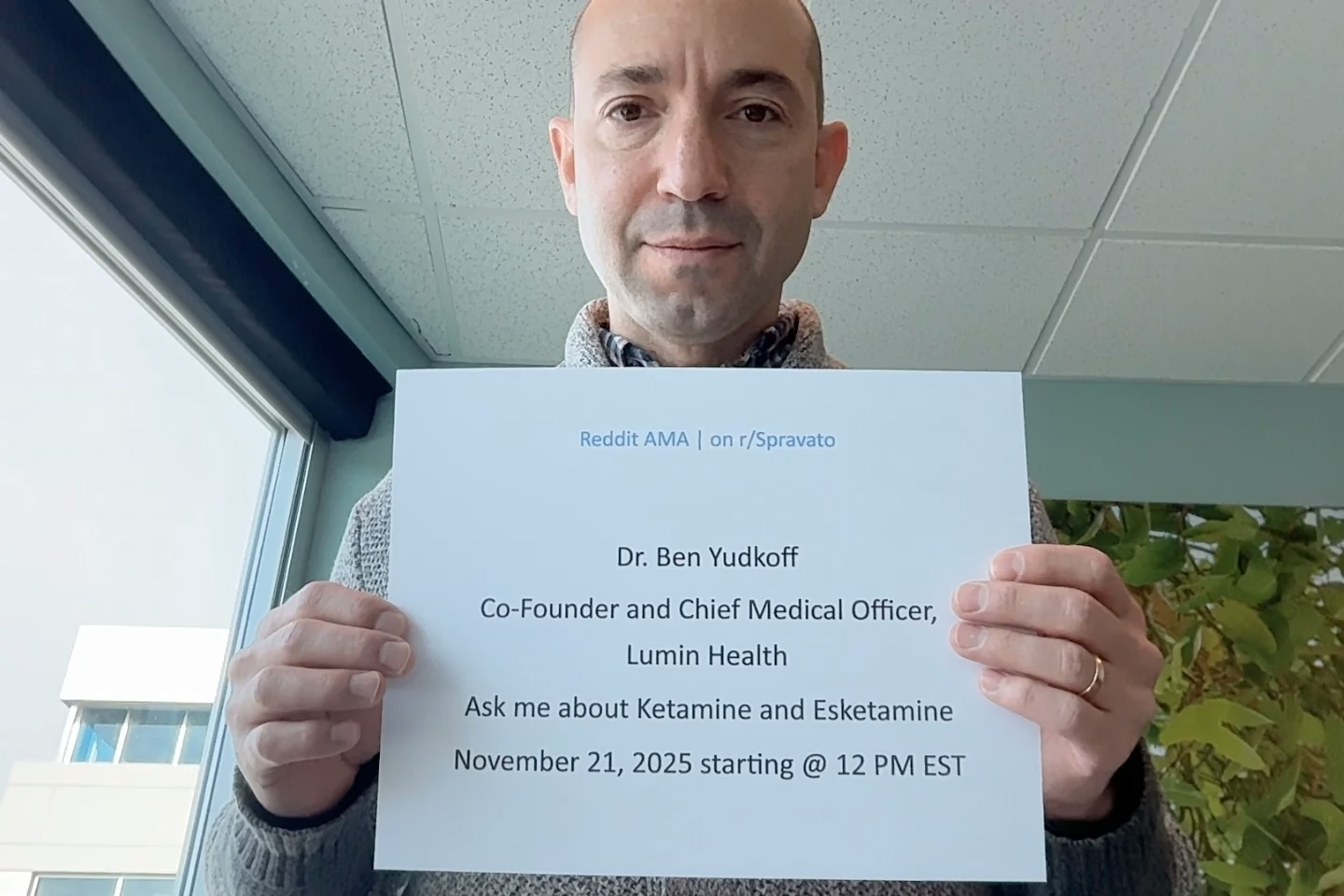
Dr. Ben Yudkoff, Co-Founder and Chief Medical Officer at Lumin Health, hosted a Reddit AMA on the Spravato community on November 21, 2025. The below blog post is a recap of one of the questions presented on that AMA, syndicated to the Lumin Health blog in the event that it answers any questions about ketamine therapy, Spravato treatment, or general concerns you may have about treatment.
Read the full AMA on r/Spravato here
Don’t hesitate to get in touch with us if you’re interested in learning more about ketamine for depression at Lumin Health. Thank you once again to the moderators and community members for facilitating such an engaging discussion.
Feisty_Bumblebee_916 asks
Hi Dr ben! I’ve been on spravato for about two months and it has completely turned my life around. I’m curious about what role you think spirituality plays in the experience because I’ve had very intense spiritual experiences, and I’ve heard that spiritually oriented people have stronger responses. Have you found that to be true? Have you ever thought about incorporating it into the treatment? I know there are psychedelic chaplains and I’ve always been curious about what that would look like on spravato
Answer:
Hi Bumblebee, thanks for your question. In different iterations of my career, I helped support the initiation of a psychedelic chaplaincy program through the Harvard Divinity School so your question is near and dear to my heart.
Let's start with some foundational principles and qualify what “spiritual” means. In the context of my response to your question, I'm going to define “spiritual” as any experience which combines the following attributes: it is 1) non-ordinary, meaning it's not part of our standard day. 2) It's an experience that connects us with something bigger than ourselves - a greater community, our ancestry, the universe, and so on. This connection with something bigger than ourselves can help us feel small but not diminished, part of something greater. 3) Spiritual experiences are often also characterized by encountering mystery and that encounter can engender feelings of fear, wonder, awe, euphoria - things that shake us out of our standard emotional repertoire. 4) Spiritual experiences are those that help us reshape how we think about our profane lives - and by profane I don't mean something corrupted or crude, but just everyday, non-sanctified, standard life.
When it comes to ketamine and Spravato there is some research that's looking at "mysticism" to see if having strong mystical experiences changes outcomes. Some research suggests that having strong mystical experiences increases the number of people who respond to the ketamine, and some research shows that actually having strong mystical experiences has little impact on whether someone responds to the medicine. If you're surprised by that, so am I!
I've started asking a different take on your question: one of the places that I'm interested in is not necessarily whether a mystical or spiritual experience helps somebody respond to the medicine but how deep and how lasting that the response is. My general sense after having done this for almost eight years, now, is that spiritual experiences may deepen a person's response, how much a person integrates that improvement into daily life, and how much a spiritual experience from Spravato and ketamine can change one's global perspective. Having spiritual experiences while under the thrall of ketamine or esketamine changes how someone relates to themselves and the world around them. People with depression tend to overvalue negative characteristics in otherwise neutral situations. When somebody takes ketamine and esketamine, for a brief window of time, a person is cast into a very different type of experiential relationship. The otherness of it can reintroduce people to categorically different kinds of experiences. A person has this window in their everyday week where the typical experience they have of themselves and of the world around them is reprieved - this can be profoundly spiritual. People can take from those moments this idea that "what I know to be true is actually perception. I'm realizing I can enter into a different state of mind and perceive the world quite differently. Couldn't it be so that, even in my every day life, what seems like things that are 'absolutely so' might just be a matter of perception." A person learns something about himself/herself/themselves. That lesson is entirely self-generated, a product of a person's own agency and insight. It's a growth moment compelled by the medicine.
The lessons learned in these more spiritually receptive states carry forward insofar as they go on to more generally inform people about so many other things in their daily life. It does enhance a person's own knowledge of themselves and is intrinsically valuable; even if spiritual moments don't materially change response rates they are valuable in and of themselves. Importantly, there are lots of ways that people can get to these spiritual moments, and they nourish us.
Long story long, it is unclear if mystical or spiritual experiences change whether or not someone has a change in benefit from ketamine and esketamine. There is a strong anecdotal signal that the very act of having these experiences simply enhances and enriches a person's experience of themselves. And there's no world in which that doesn't pay dividends in terms of how a person thinks of themselves as having value, being a curious member of this world, and how a person relates to the world around oneself, and so that's primarily how I talk about it with patients.
Take the first step today.
If you or a loved one in Massachusetts and the greater Washington DC/Maryland area is struggling with depression or anxiety, Lumin Health's team of experts is ready to help. Book a free 20-minute consultation to learn if ketamine therapy could be the breakthrough you've been looking for.
Available in Massachusetts and the greater Washington DC/Maryland area.