

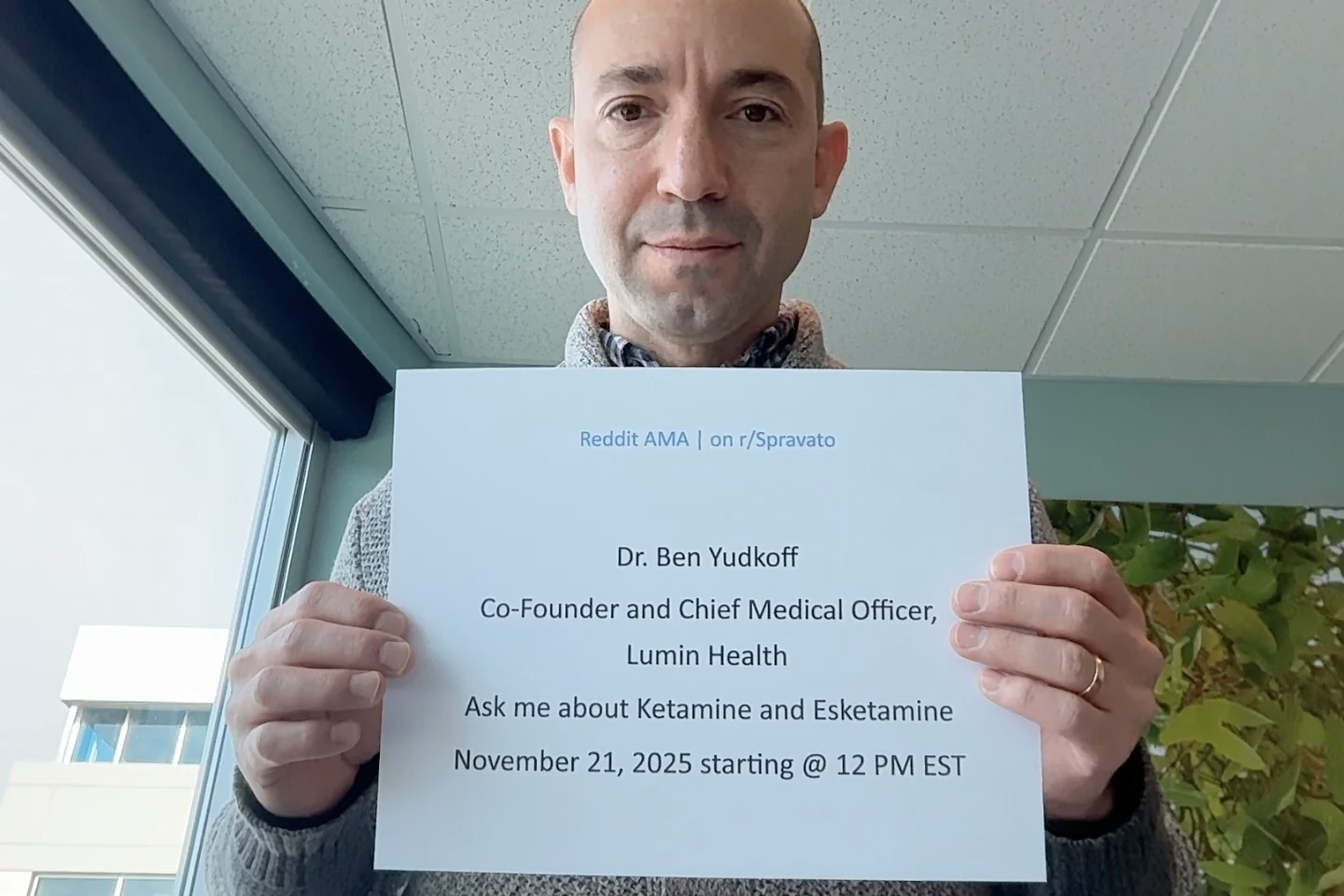
Dr. Ben Yudkoff, Co-Founder and Chief Medical Officer at Lumin Health, hosted a Reddit AMA on the Spravato community on November 21, 2025. The below blog post is a recap of one of the questions presented on that AMA, syndicated to the Lumin Health blog in the event that it answers any questions about ketamine therapy, Spravato treatment, or general concerns you may have about treatment.
Read the full AMA on r/Spravato here
Don’t hesitate to get in touch with us if you’re interested in learning more about ketamine for depression at Lumin Health. Thank you once again to the moderators and community members for facilitating such an engaging discussion.
Fearless-icecream asks four questions in one:
- Is Spravato supposed to be stronger than IV Ketamine?
- How can you tell if it is actually causing neuroplasticity?
- How long should you do it for, when should you stop?
- Can you build a tolerance, and if yes, what can you do about it to keep having the same effect (the same deep reflective thoughts like at the beginning instead of just not feeling much)?
Answer:
Fearless! Love your handle.
- No! Technically, esketamine - the molecule that makes up Spravato is the active component of ketamine and, therefore, is just as strong. But here's the rub: the higher dose of Spravato - 84 mg - is dosed at the equivalent of 0.2 mg/kg of ketamine which is on the lower side of a ketamine dose delivered over 40 minutes. Because the dose is relatively lower than standard IV ketamines, I would say that it is a gentler medicine.
- Great question. This is hard and sort of impressionistic. Habits should feel easier - getting up in the morning at a regular time, for example, wanting to take a meal at regular times, etc. Self reproach should soften. Pessimism gives way to neutrality or (quite potentially) cautious optimism. Things seem less futile (cool article on this -- https://pubmed.ncbi.nlm.nih.gov/39694033/). Things just get automatic. Most people recognize this in hindsight -- a person may be doing something totally regular, like folding laundry, and suddenly realize how much easier the week was, and how much they were less bothered by depressive thoughts.
- Super-idiosyncratic -- a person should engage in the treatment for as long as they think they need it (it's ok to not know right now or not know for sure), then start spacing out the treatments to see for how long he/she/they maintains recovery without regular treatment. Some people can stop, some people need to come back as needed, some people can space treatments out every 4 weeks, and some people continue to get benefit coming in weekly or every other week. It's totally individualistic. The plan requires some improvisation and that's ok -- be sure to work with a medical practice that can ride alongside this approach. Most people stay at a weekly-to-every-other week cadence if it's working, but not all, and every decision should be made based on the individual person's needs.
- Yes, you can! And it's strange and somewhat unexpected. But yes. But developing tolerance to the subjective changes (less trippy-ness) does not necessarily correlate with diminished efficacy. There's not much a person can predictably do to maintain the deep reflective thoughts. Again, these moments may not be necessary for maintaining improvement but are certainly important in terms of personal transformation. If you can, try skipping a treatment to give your brain a chance to lose some tolerance. You may find that this helps you get to those deeper thinking places with little-to-no consequence on efficacy. If you've tried this approach, or skipped a treatment because of a vacation, etc. and found that depressive symptoms rebounded, this might not be the best approach for you.
You've read the science. Now take the next step.
Lumin Health provides safe, expert-administered ketamine and Spravato treatment across Massachusetts and the greater Washington DC/Maryland area. Your journey starts with a free, no-commitment intro call.
Available in Massachusetts and the greater Washington DC/Maryland area.