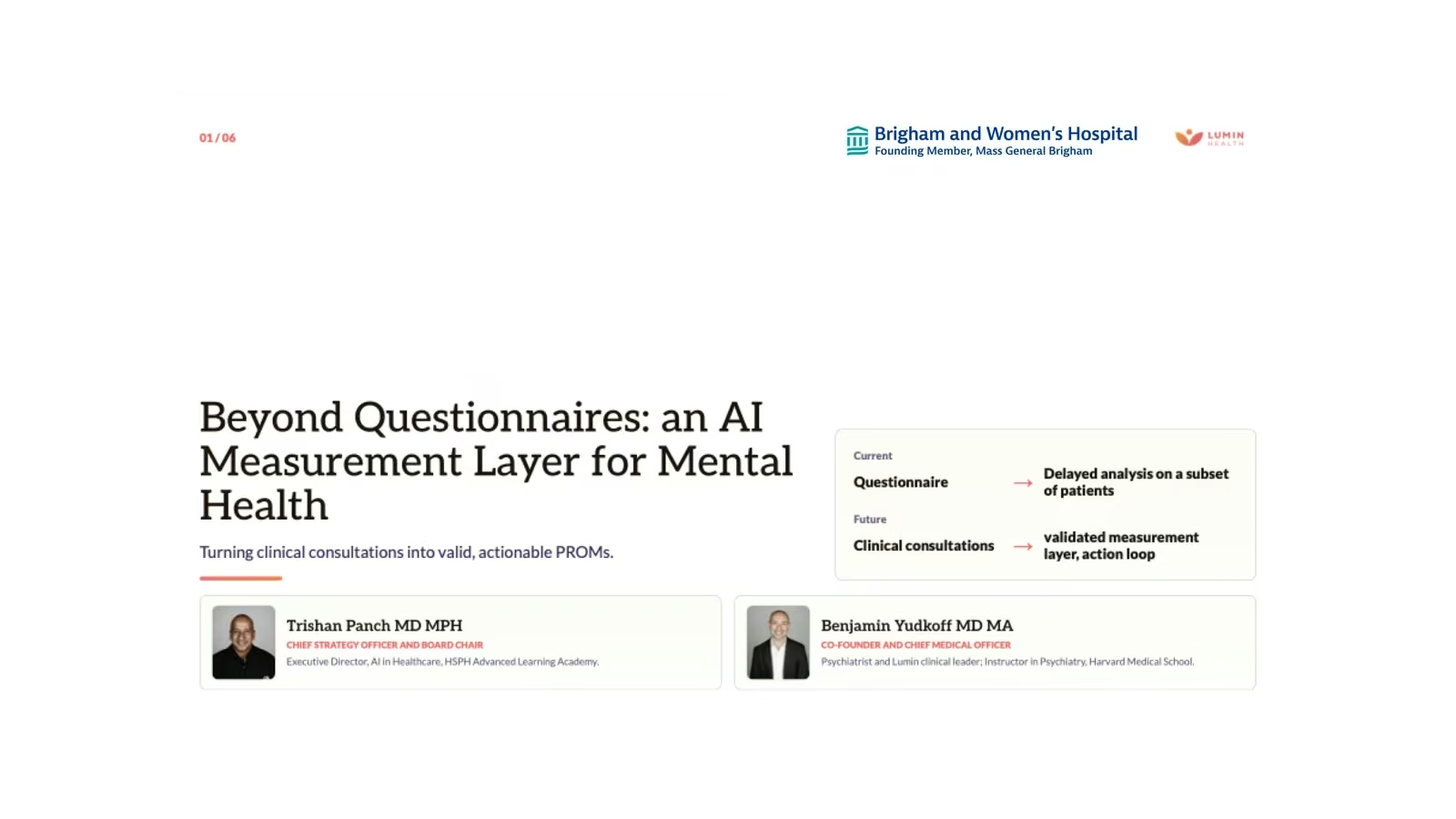



In an eight-part Psychiatric Times Insights video series, Dr. Ben Yudkoff and Gene Dolgin of Lumin Health explain how treatment-resistant depression is defined, where esketamine (Spravato, FDA-approved) fits among interventional options, how safety is built into every session, and what it takes to design care around the person receiving it.
Psychiatric Times is read widely by psychiatrists and other prescribers. The series, Esketamine in Treatment-Resistant Depression: Evidence, Safety, and Practice-Building, was published October 5 and 6, 2026. It features our Chief Medical Officer and Co-Founder, Dr. Ben Yudkoff, and our Co-Founder and CEO, Gene Dolgin. It was made for clinicians. But much of it speaks directly to anyone living with depression that has not lifted, and to the people who love them. Here is what we hope you take from it.
What Treatment-Resistant Depression Means, in Dr. Yudkoff's Words
The series opens with a definition, and an honest caveat about it.
"Treatment refractory depression has no absolute definition, but by and large, the community regards failure or inadequate response to two antidepressants of adequate dose and adequate duration in the concurrent episode of depression constitutes treatment refractory."
— Dr. Ben Yudkoff, Chief Medical Officer, Lumin Health, in Psychiatric Times
Most antidepressants work on the monoamines: serotonin, norepinephrine, and dopamine. For many people they help. For others, Dr. Yudkoff says, they are simply not enough.
"For about a third of people who are experiencing depressive symptoms, these particular modalities of treatment aren't sufficient."
— Dr. Ben Yudkoff, Chief Medical Officer, Lumin Health, in Psychiatric Times
If that describes your experience, it is not a personal shortcoming. The treatment did not do enough for you, and there are other options to consider. Insurers also add their own nuance to how treatment-resistant depression is defined, which is one reason we review each person's history and coverage carefully before recommending a path.
Where Ketamine and Esketamine (Spravato) Treatment Fits Among Interventional Options
The second episode walks through the options psychiatrists consider when first-line treatments fall short. These include structured programs such as inpatient care, partial hospitalization, and intensive outpatient programs, as well as electroconvulsive therapy (ECT), transcranial magnetic stimulation (TMS), ketamine therapy, and esketamine (Spravato). Each has its own character. Dr. Yudkoff is clear that no single option is right for everyone.
"At the heart of it all lies the patient preference."
— Dr. Ben Yudkoff, Chief Medical Officer, Lumin Health, in Psychiatric Times
That preference is practical as much as clinical. Can you take time off work? Can you arrange a ride to and from treatment? Is care available near you? On esketamine specifically, he points to what FDA approval changed for access.
"Esketamine, in contrast, is very often paid for by insurances, which makes accessibility quite extraordinary for people who wouldn't otherwise have access to it because of costs."
— Dr. Ben Yudkoff, Chief Medical Officer, Lumin Health, in Psychiatric Times
Choosing Between Ketamine Therapy and Esketamine (Spravato)
Lumin Health offers both esketamine (Spravato) and intramuscular (IM) ketamine, an evidence-based, off-label use of a medicine that has been in use for over 50 years. In the fourth episode, Dr. Yudkoff explains how he thinks about the choice. Their safety profiles are largely the same. Ketamine allows more flexibility in dosing. Esketamine is FDA-approved, delivered under a strict, regulated program, and much more often covered by insurance. His starting point is sustainability.
"I try to steer patients towards the medication that's covered by insurance simply because it's sustainable."
— Dr. Ben Yudkoff, Chief Medical Officer, Lumin Health, in Psychiatric Times
Money not spent on treatment can go to the rest of your life, which he describes as part of recovery too: time with people you love, a good meal, a museum. You can read more about how the two medicines differ on our ketamine and esketamine page, and check your coverage on our insurance page.
The Evidence Behind Esketamine, and the Real Cost of Care
In the third episode, Dr. Yudkoff points readers who want the research to the TRANSFORM and SUSTAIN studies, the trials behind esketamine's FDA approval[1]. He also takes on a common critique, that generic ketamine is a cheaper alternative.
"The medication cost might be very low, but that's not the cost of care delivery."
— Dr. Ben Yudkoff, Chief Medical Officer, Lumin Health, in Psychiatric Times
Safe care includes the space, the trained staff, and the monitoring equipment around every session. He also makes a point we see every day. Coming in for care is part of the treatment.
"The very act of receiving care is itself a treatment."
— Dr. Ben Yudkoff, Chief Medical Officer, Lumin Health, in Psychiatric Times
How Safety Is Built Into Every Session
In the fifth episode, Dr. Yudkoff describes safety as starting long before any medicine is given.
"A relationship is the vehicle by which treatment is provided."
— Dr. Ben Yudkoff, Chief Medical Officer, Lumin Health, in Psychiatric Times
From there come a careful medical evaluation, coordination with your other doctors when needed, a calm and private setting, and continuous monitoring, including vital signs and oxygen levels. After an esketamine (Spravato) session, you stay with us for two hours or more of observation, and you cannot drive yourself home. He also speaks to why people come to us at all.
"Vulnerability precedes my request for help."
— Dr. Ben Yudkoff, Chief Medical Officer, Lumin Health, in Psychiatric Times
The same episode covers why people pause treatment, which is usually for ordinary reasons: an insurance change, a move, a semester abroad. Some people, feeling better, want to see how they do on their own. Whatever you decide, he wants you to know the door stays open.
Designing Care Around the Person, Not the Process
In the sixth and eighth episodes, Gene Dolgin and Dr. Yudkoff describe how Lumin Health was built: in-network with insurers, certified to provide esketamine, and organized around each visit from the moment you walk in. Every session at Lumin Health happens in a private room rather than a shared one. Gene describes the relationship between a practice and the people it serves this way.
"We need them to come to the places we offer care in as much as they need the care."
— Gene Dolgin, Co-Founder and CEO, Lumin Health, in Psychiatric Times
He also remembers reading the first patient review, and what it said about the care behind the medicine.
"It was the place that they came to. It was the people that they engaged with."
— Gene Dolgin, Co-Founder and CEO, Lumin Health, in Psychiatric Times
You can see what a visit looks like on The Lumin Health Experience.
For Psychiatrists and Prescribers Weighing Interventional Care
The seventh episode is written for colleagues weighing whether to offer this kind of care. Dr. Yudkoff is candid about prior authorizations, documentation, and the weight of caring for people at their most vulnerable. He is equally clear about the reward.
"This is an immensely gratifying practice to run."
— Dr. Ben Yudkoff, Chief Medical Officer, Lumin Health, in Psychiatric Times
Watch the Full Psychiatric Times Series
All eight episodes are free to watch on Psychiatric Times:
- Episode 1: Defining Treatment-Resistant Depression in Adults – how TRD is defined and the medication and augmentation steps that usually come first.
- Episode 2: Interventional Options for TRD: ECT, TMS, and Esketamine – structured programs, ECT, TMS, ketamine and esketamine, and how patient preference shapes the choice.
- Episode 3: Esketamine in TRD: The Evidence Base and the Cost Critique – the TRANSFORM and SUSTAIN trials, and why the price of a drug is not the cost of delivering care.
- Episode 4: Choosing Between Ketamine and Esketamine in TRD – how Dr. Yudkoff weighs the two, with sustainability and insurance coverage first.
- Episode 5: Safety Monitoring and Treatment Continuation With Esketamine in TRD – safety as a relationship first, and why people pause treatment.
- Episode 6: Building an Interventional TRD Practice: From Setup to the Patient Experience – what goes into a treatment day, from arrival to the ride home.
- Episode 7: Advice for Clinicians Considering an Interventional TRD Practice – what clinicians should know before building this kind of practice.
- Episode 8: Running a Sustainable Esketamine Treatment Center for TRD – private rooms, staffing for one-on-one care, and warmth as an operating principle.
Dr. Yudkoff also appeared in two earlier Psychiatric Times videos: Mechanisms of Ketamine and Beyond Monoamines: Ketamine and Interventional Psychiatry. You can find all of our coverage in the Lumin Health newsroom.
Exploring Whether Esketamine or Ketamine Therapy May Be a Fit
Lumin Health is a psychiatrist-led practice with locations across Massachusetts and in Bethesda, Maryland. If depression has not lifted for you despite treatment, we would be grateful to walk with you toward understanding whether esketamine (Spravato) or ketamine therapy may be a fit.
References
- Popova V, Daly EJ, Trivedi M, et al. Efficacy and Safety of Flexibly Dosed Esketamine Nasal Spray Combined With a Newly Initiated Oral Antidepressant in Treatment-Resistant Depression: A Randomized Double-Blind Active-Controlled Study. Am J Psychiatry. 2019;176(6):428-438. PubMed
Explore whether this may be a fit.
If depression has not lifted despite treatment, our team can help you understand whether esketamine (Spravato) or ketamine therapy may be right for you. Book a free 20-minute consultation. There is no pressure, and the information is yours to keep.
Available in Massachusetts and the greater Washington DC and Maryland area.
Frequently Asked Questions
What is the Psychiatric Times series featuring Lumin Health about?
It is an eight-part Psychiatric Times Insights video series, published October 5 and 6, 2026, featuring Dr. Ben Yudkoff and Gene Dolgin of Lumin Health. It covers how treatment-resistant depression is defined, where esketamine (Spravato) fits among interventional options, how safety is managed, and how care is designed around each patient.
Is esketamine (Spravato) FDA-approved?
Yes. Esketamine (Spravato) is FDA-approved for adults with treatment-resistant depression and for major depressive disorder with acute suicidal ideation or behavior, in conjunction with an oral antidepressant. Ketamine therapy for depression is an evidence-based, off-label use.
How long is the observation period after a Spravato session?
After each esketamine (Spravato) session you stay on-site for two hours or more while our team monitors you. You cannot drive yourself home afterward, so plan a ride, public transit, or a walk if you live close by.
Does insurance cover esketamine (Spravato)?
Esketamine (Spravato) is covered by most major insurers in Massachusetts for its FDA-approved indications, which is a key reason Dr. Yudkoff calls it the more sustainable option for many people. Coverage varies by plan, so check with your insurer or use our insurance page at lumin.health/insurance-we-accept.