


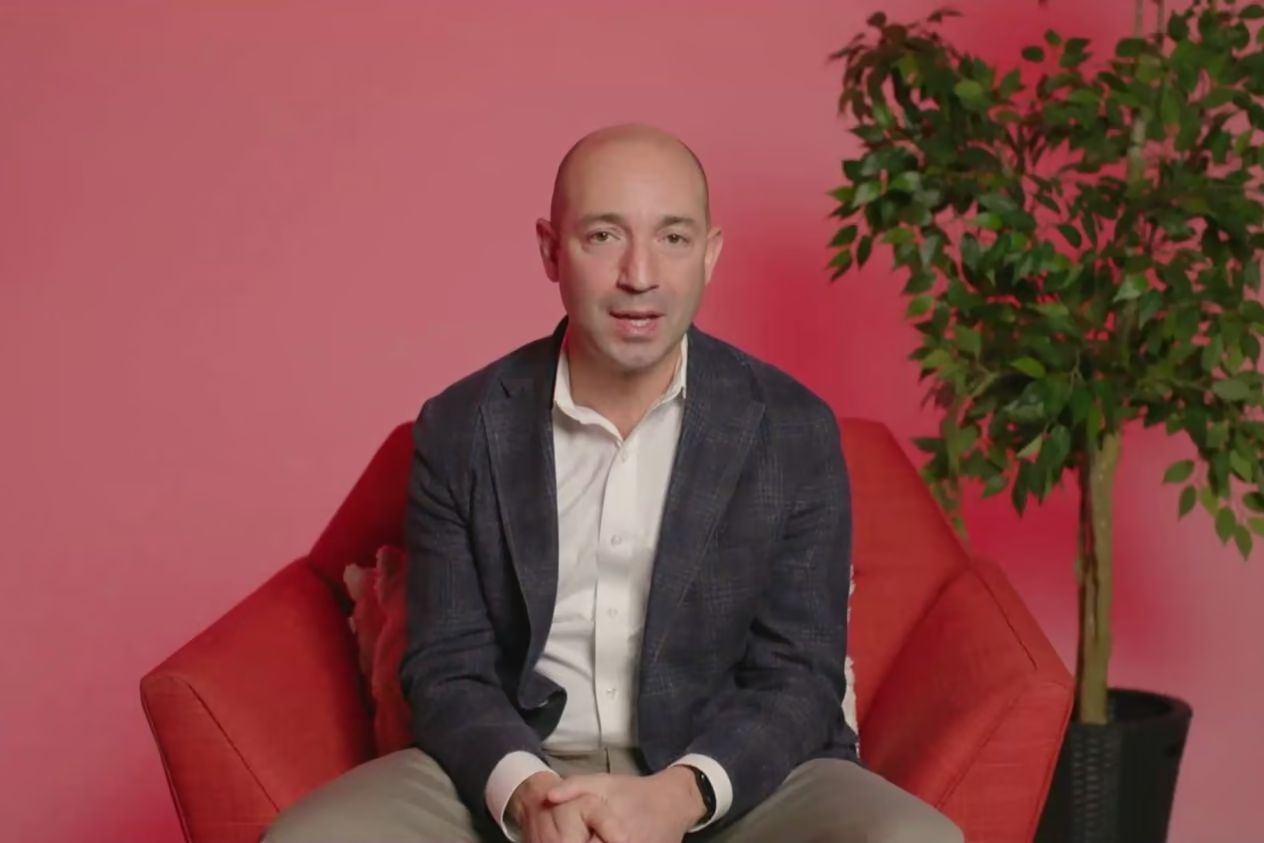
Dr. Ben Yudkoff, Chief Medical Officer and co-founder of Lumin Health, answers common questions about ketamine and esketamine (Spravato) for depression, from who may be a candidate and what a session feels like to safety, dosing, maintenance, and insurance.
In a live session in October 2026, Dr. Yudkoff answered questions from people curious about ketamine and esketamine (Spravato). If you are weighing these treatments for yourself or someone you love, we hope his answers help you feel more informed and less alone with the decision.
The Basics: How Ketamine and Esketamine (Spravato) Came to Treat Depression
Dr. Yudkoff has spent roughly eight to nine years working with these medicines. Before taking questions, he walked through a short history. Ketamine was approved by the FDA in 1970 as an anesthetic. Soon after, psychiatrists published early reports of benefit in depression and alcohol use disorder. Then research went quiet for nearly three decades.
It resurfaced in 2000 with a landmark clinical paper. Dr. Yudkoff described that period as the moment ketamine's rapid effects on depression and suicidal thoughts came back into view. Enthusiasm for SSRIs had faded, and researchers were looking at glutamate and the NMDA receptor as targets for new antidepressants. By about 2010, rigorous double-blind, placebo-controlled studies were showing promising results.
How ketamine works, in plain language
Ketamine briefly increases the release of glutamate, the brain's main "go" signal, which stimulates the brain cells that respond to it. Dr. Yudkoff compares this to exercise. The right stress, for the right length of time, with rest in between, builds muscle instead of injuring it. Brain cells respond in a similar way. "And brain cells become more brain cell-y," he said. They reach out and connect.
That matters because, in depression, the number of brain cells is thought to stay the same while the connections between them decrease. Ketamine is thought to help restore some of that connectivity. It also appears to touch the brain's own endorphin signaling, the default mode network (the network most active during self-focused thinking and rumination), and a circuit involving support cells called astrocytes that may help the brain flag a situation as futile. Ketamine has also been studied in OCD, anxiety, and PTSD. Learn more about the science behind ketamine.
Where esketamine (Spravato) fits
Esketamine (Spravato) came to market in 2019. It is the S-enantiomer of ketamine, one of ketamine's two mirror-image forms, and it is given as a nasal spray. Esketamine (Spravato) is FDA-approved for adults with treatment-resistant depression and for depressive symptoms in adults with major depressive disorder with acute suicidal ideation or behavior. Ketamine for depression, by contrast, is an evidence-based, off-label use of a medicine that has been in use for more than 50 years.
Dr. Yudkoff called esketamine "a game changer" for moving depressions that have been stuck. As he put it: "It's the only medicine in psychiatry that has an FDA approval for treating suicidality."
Who Ketamine and Spravato Treatment May Be Right For
Who is ketamine or esketamine (Spravato) treatment right for?
For esketamine (Spravato), Dr. Yudkoff said eligibility is relatively clear. It is generally for adults whose depression has not responded adequately to at least two antidepressants and is severe enough on standard scales, or for adults with major depressive disorder and suicidal thoughts. Insurers add their own nuances, such as requiring two or four antidepressant trials, augmentation medicines like lithium or aripiprazole, or prior psychotherapy. Lumin Health works with you to sort out what your plan will approve.
Ketamine is used off-label, so you and your provider decide together whether it fits. That range is wider, including major depression, bipolar depression, certain anxiety disorders, OCD, and PTSD when severity warrants it. "The symptoms that drive a lot of these different disorders share common pathways in the brain," he explained. It also helps to know who may not be a good candidate for ketamine therapy.
Do you need a referral to start, and how does insurance checking work?
No referral is needed. You can call Lumin Health directly, and referrals from your existing providers are welcome too. Dr. Yudkoff explained that Lumin Health makes the eligibility determination itself, through an in-house medical necessity evaluation. That evaluation looks at three things: whether your condition may improve with ketamine or esketamine, which options are insurance-covered and which are not, and any medical conditions that affect safety.
Care is also deliberately not delivered in a vacuum. With your consent, the team communicates with your existing providers about how treatment is going and about major life events, which he described as a core safety feature. You can review plans we work with on our insurance page.
What should you look for in a ketamine provider?
Dr. Yudkoff named two criteria. The first is safety, meaning trust. "This treatment requires a sense that you trust the provider," he said, and that provider should be able to hold the full range of experiences people have. The second is mastery: deep knowledge of the medicine's biology and its experiential side, and a clear answer when you ask what happens if treatment does not go as expected.
His own bias is that these medicines are best delivered by psychiatrists or psychiatric nurse practitioners, who can sit with the painful self-beliefs that often come with depression, though he called that a preference rather than a rule. Proximity matters too. You cannot drive home after treatment, so rides and support need to be part of the plan.
What a Ketamine or Esketamine Session Feels Like
What does a ketamine or Spravato session feel like if you have never tried it?
Onset is fairly quick. Dr. Yudkoff described deep relaxation, warmth, tingling in the fingers and toes, and a sense that something is in your system, followed by a transition. Our usual sense of self is a blend of thinking, knowing, and observing that rarely comes apart. During a session, those parts can separate. "It's as if there's a stream that's coming through, presenting thoughts, memories, and it feels somehow different from myself," he said.
Your sense of your body can shift, and music may feel like an environment. Some people briefly lose track of who or where they are, which can feel wonderful or jarring, and staff help you through uncomfortable moments. Most describe the experience as strange, interesting, or awe-inspiring rather than unpleasant. His advice to families is to be curious and ask. More on what treatment feels like.
If you dislike dissociating, is ketamine a bad idea?
Not necessarily. Dr. Yudkoff called it a deeply personal choice. "Not everybody enjoys the experience. What they enjoy is the benefit," he said, comparing it to exercising begrudgingly because you value the result. If the experience is uncomfortable, there are comfort measures, including medicines that can be given alongside a session to soften the intensity of dissociation. You can read more about dissociation in ketamine treatment and how it is supported.
What is the setting like during treatment, and does it matter?
Dr. Yudkoff described any treatment center as "a sequence of enterings." At Lumin Health, you move from the noise of the outside world into a waiting room designed to feel warm and a little luxe, with a small library of books meant to spark curiosity.
Treatment rooms are darker, quieter, and less stimulating, with an enclosed feeling that signals it is time to turn inward. This is what people mean by "set and setting." Staff are a big part of the environment, holding both the seriousness of what brings you in and the lightness of your joy, and staying present with you during treatment. Take a closer look at Lumin Health's treatment rooms.
What is the relational side of treatment at Lumin Health?
"Nothing happens outside the context of relationship," Dr. Yudkoff said. People seeking help are vulnerable, and severe depression often erodes self-regard. So the care model is built on unconditional regard, an idea he credited to psychotherapist Carl Rogers, and on honoring the courage it takes to ask for help.
He described flipping the usual medical dynamic. Instead of the patient needing the provider, the stance is that the provider wants you here. Your agency in seeking help is the active ingredient, and the medicine is secondary. The physical space is meant to feel joyful, competent, accountable, and safe.
How Long Ketamine and Spravato Benefits Last
How much maintenance is needed after the first course?
Nobody really knows in advance, Dr. Yudkoff said. "And so the process of maintenance is really iterative and it usually declares itself." Treatment has named phases. What's called an "index course" is about four weeks of twice-weekly treatments. Optimization moves to once weekly to see how your response holds. Anything beyond about two months is maintenance.
Some people settle into a weekly or every-other-week rhythm after noticing symptoms return when they miss a dose. Others pause on purpose to see whether progress from psychotherapy or their own self-guided practice, healthy habits, and life changes can carry them. Lumin Health keeps care as non-algorithmic as possible, with a safety net if symptoms return. See our overview of ketamine maintenance after the initial course.
Can esketamine (Spravato) be used just to get through an acute period?
Yes. Dr. Yudkoff said some people use esketamine for an acute bout of depression that has not responded to standard treatment. It does the trick, and they stop because they feel their improvement is locked in. The FDA labeling can give the impression that everyone needs maintenance, but that is not always the case.
What comes after treatment matters. He described it as building healthy habits and reasserting your sense of self, not only processing what came up in sessions. If stopping predictably brings depression back, an individualized maintenance plan can be designed. He encouraged people to talk openly with their provider about their priorities.
How do ketamine's long-term effects compare with psilocybin therapy?
Dr. Yudkoff called it an apples-to-oranges comparison. Psilocybin is still investigational, and its studies measure benefit over months, at four, eight, and twelve weeks. For people who respond to ketamine or esketamine, symptoms often return around four weeks after stopping, on average. "And ketamine has not shown the same durability as things like psilocybin," he said. Durability is one of several factors to weigh when choosing a treatment, alongside access and evidence. He goes deeper in his longer comparison guide.
If therapy and life changes have helped, will you stay well after stopping?
No one can predict it for an individual, Dr. Yudkoff said. Studies measure depression rating scales, not quality of life. On average, "responders," who improved but still have some symptoms, mostly relapse within about a month of stopping. "Remitters," who are essentially symptom-free, can last much longer, though study lengths leave that window undefined.
His approach is to share the evidence, be clear it describes averages and not you, talk through what risk feels acceptable, and keep a safety net so restarting is easy. He compared it to remission in cancer care, with regular check-ins. You can also read when to stop Spravato.
Ketamine and Esketamine Safety
How do ketamine and esketamine affect the heart?
Heart health matters for safety and comfort, not for how well the medicine works. "So both ketamine and esketamine can cause transient increases in blood pressure and heart rate, about the equivalent of walking up two or three flights of stairs," Dr. Yudkoff said. Blood pressure rises about 10 to 20 points on average. Most people tolerate this well. If you have had a heart attack or a coronary stent, a quick cardiac check helps confirm you can handle 30 to 90 minutes of elevated heart rate. After each esketamine (Spravato) dose, you are monitored for two hours or more.
Are there other effects on the body with years of regular use?
Dr. Yudkoff named a few areas. Aneurysms and similar blood vessel abnormalities need to be disclosed, because a rise in blood pressure could raise rupture risk, and they can make someone ineligible. Bladder irritation is a known risk with heavy, unsupervised ketamine use. In medically supervised treatment he described it as extremely rare, and providers look into it if urinary symptoms appear. Read about bladder health and ketamine.
He also pointed to about six years of long-term data from Janssen, a Johnson & Johnson company, on regular esketamine use, covering cognition, bladder, and heart. "And so as far as we know, on average, with a six-year look back, there are no significant signals about long-term impacts of the use of ketamine, and especially esketamine," he said.
Do gut problems affect how ketamine or esketamine is absorbed?
No. Both medicines deliberately bypass the digestive tract, partly because the liver breaks down much of any swallowed dose. Lumin Health gives ketamine as an intramuscular (IM) injection, and esketamine (Spravato) is absorbed through the lining of the nose, so both reach the bloodstream directly. "And so gut motility issues should not play a role in impacting the absorption of either of these medicines," Dr. Yudkoff said. Here is why Spravato is a nasal spray.
Dosing and Choosing Between Ketamine and Esketamine (Spravato)
If insurance weren't a factor, would you choose ketamine or esketamine?
Personally, Dr. Yudkoff said he would choose intranasal esketamine, because he avoids needles. Ketamine's main advantage is a much wider dose range, which allows real individualization, while esketamine has essentially two doses and a set maximum. He noted that racemic ketamine (a mix of both mirror-image forms) may be somewhat more effective overall, though he described the difference as modest.
Access often decides it. Esketamine is usually insurance-covered and widely available, while ketamine is typically out of pocket. Compare them side by side in Spravato vs. ketamine, and review ketamine treatment costs.
How flexible is ketamine and esketamine dosing?
Most research on ketamine used a fixed dose of 0.5 mg per kilogram of body weight. Dr. Yudkoff said real-world care often needs flexibility. At Lumin Health, ketamine doses range from 0.3 to 2.0 mg/kg, adjusted based on your response.
Esketamine (Spravato) follows a fixed regimen. Most people start at 56 mg, the majority move to 84 mg, and 70 mg is an in-between option. Most people who respond do so within that regimen. He compared it to oral antidepressants that come in a few set strengths. Those fixed doses reflect what was studied and what insurers reimburse, not a sign that esketamine is less effective.
What is known about R-ketamine?
Ketamine comes in two mirror-image forms, S and R. R-ketamine was initially passed over because it acts less strongly at the NMDA receptor, but it also seems to cause less dissociation. Dr. Yudkoff said research in Australia and Europe is showing promising early results, with US trials at earlier stages. How it compares with racemic ketamine and esketamine is still being worked out. More in our explainer on S-ketamine vs. R-ketamine.
Do any oral antidepressants act on the same receptors as ketamine?
A few come close. Dr. Yudkoff pointed to a newer FDA-approved medicine that combines bupropion and dextromethorphan (Auvelity). Dextromethorphan blocks the NMDA receptor, and bupropion slows its breakdown so more reaches the brain. Some people respond, though it has not fully delivered on early hopes. Some psychiatrists also use NMDA-modulating medicines like memantine or lamotrigine as add-ons.
The key caveat is that ketamine and esketamine act on much more than the NMDA receptor, and these medicines do not replicate that broader effect. Read more in Auvelity vs. Spravato and ketamine.
Does it matter that ketamine is synthetic rather than natural?
Ketamine is a manufactured pharmaceutical with no known natural counterpart. Dr. Yudkoff does not think that matters. The brain cannot tell natural from synthetic. It simply responds to which receptors a molecule activates. Whole-plant medicines may carry companion compounds with their own effects, he acknowledged, but the brain still just registers the pharmacology.
Getting Started With Ketamine Treatment and Insurance
Is ketamine-assisted psychotherapy covered by insurance?
Psychotherapy is not part of Lumin Health's services. Our care focuses on ketamine and esketamine treatment, and some people choose to work with an outside therapist on their own. Dr. Yudkoff still offered a clear view of coverage. The pivotal question is whether an insurer classifies ketamine-assisted psychotherapy as psychotherapy. If it does, a standard psychotherapy billing code may apply. If not, there is no sign yet of a separate billing code for this kind of care.
He noted that a 2024 FDA application for a different medicine, packaged together with psychotherapy, was not approved, partly because regulators struggled to separate the effect of the medicine from the effect of the therapy. Some therapists bill standard codes with time extensions for longer sessions, which depends on the insurer. Read more on whether ketamine-assisted psychotherapy is covered by insurance.
Can transportation be covered or arranged?
You cannot drive after treatment, so getting home safely is part of every plan. Dr. Yudkoff said some areas offer transportation help, and the Lumin Health team can help you plan rides to and from your sessions. There is not yet a universal answer for covering ride costs, and it is something the team continues to explore. Learn more about driving after Spravato or ketamine treatment.
The Science Still Emerging
Several of Dr. Yudkoff's answers came back to one honest point. Much remains unknown, especially about who will stay well after stopping and how newer options like R-ketamine will compare. What he offered instead was a way of working: share the evidence plainly, be clear that averages are not individuals, make decisions together, and keep the door open. That is how we try to practice at Lumin Health, with locations across Massachusetts and Bethesda, Maryland.
Closing the session, he put it simply: "It's complicated. It's wonderful. It's different. It's uncertain." Whatever you decide, we hope you stay curious and stay connected to people who can support you.
Further reading
- Berman RM, Cappiello A, Anand A, et al. Antidepressant effects of ketamine in depressed patients. Biol Psychiatry. 2000;47(4):351-354. https://pubmed.ncbi.nlm.nih.gov/10686270/
- Li N, Lee B, Liu RJ, et al. mTOR-dependent synapse formation underlies the rapid antidepressant effects of NMDA antagonists. Science. 2010;329(5994):959-964. https://pubmed.ncbi.nlm.nih.gov/20724638/
- Bahji A, Vazquez GH, Zarate CA Jr. Comparative efficacy of racemic ketamine and esketamine for depression: a systematic review and meta-analysis. J Affect Disord. 2021;278:542-555. https://pubmed.ncbi.nlm.nih.gov/33022440/
- McIntyre RS, Rosenblat JD, Nemeroff CB, et al. Synthesizing the evidence for ketamine and esketamine in treatment-resistant depression: an international expert opinion on the available evidence and implementation. Am J Psychiatry. 2021;178(5):383-399. https://pubmed.ncbi.nlm.nih.gov/33726522/
- Daly EJ, Trivedi MH, Janik A, et al. Efficacy of esketamine nasal spray plus oral antidepressant treatment for relapse prevention in patients with treatment-resistant depression: a randomized clinical trial. JAMA Psychiatry. 2019;76(9):893-903. https://pubmed.ncbi.nlm.nih.gov/31166571/
- Short B, Fong J, Galvez V, Shelker W, Loo CK. Side-effects associated with ketamine use in depression: a systematic review. Lancet Psychiatry. 2018;5(1):65-78. https://pubmed.ncbi.nlm.nih.gov/28757132/
Frequently Asked Questions
Who is esketamine (Spravato) or ketamine treatment right for?
Esketamine (Spravato) is FDA-approved for adults with treatment-resistant depression and for depressive symptoms in adults with major depressive disorder with acute suicidal ideation or behavior, and insurers add their own criteria. Ketamine is used off-label, so you and your provider decide together whether it fits, including for some people with bipolar depression, anxiety, OCD, or PTSD.
What does a ketamine or Spravato session feel like?
Dr. Ben Yudkoff describes a fairly quick onset of deep relaxation, warmth, and tingling, followed by a shift in which thoughts and memories can feel somewhat separate from yourself. Most people describe it as strange, interesting, or awe-inspiring rather than unpleasant, and staff are present to help you through uncomfortable moments.
How long do the benefits of ketamine or esketamine last?
It varies. On average, people who improve but still have some symptoms often see symptoms return within about a month of stopping, while people who become essentially symptom-free can stay well much longer. Maintenance is usually worked out over time with your provider.
Are ketamine and esketamine safe for the heart?
Both can briefly raise blood pressure and heart rate, about like walking up two or three flights of stairs, and most people tolerate this well. People with a history of heart attack or coronary stents may need a quick cardiac check first, and you are monitored after each esketamine (Spravato) dose for two hours or more.
Do you need a referral to start ketamine or Spravato treatment at Lumin Health?
No referral is needed. Lumin Health completes its own medical necessity evaluation, which looks at whether treatment may help, which options your insurance covers, and any medical safety considerations.